
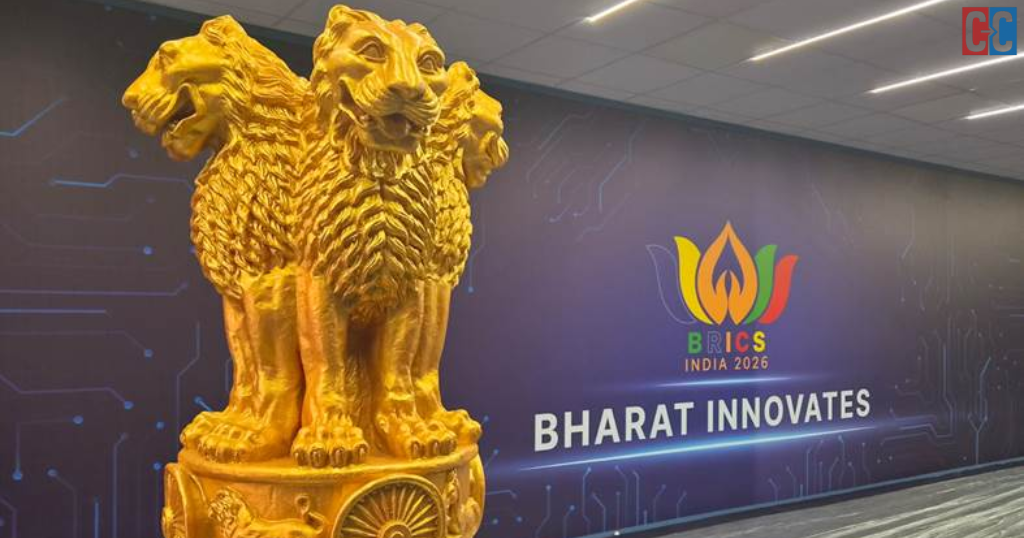
New Delhi: The Union Ministry of Education, working with the Ministry of External Affairs, opened the two-day BRICS Bharat Innovates (BBI) Exposition at Bharat Mandapam on September 11, putting 37 Indian deep-tech startups before CEOs, investors, and government delegations gathered ahead of the 18th BRICS Summit on September 12-13.
The ventures were drawn from an original cohort of 120 startups that represented India at the first Bharat Innovates exposition, held in Nice, France, in June, as part of the India-France Year of Innovation, spanning sectors from artificial intelligence and semiconductors to biotechnology, space, and defence technology. The Delhi edition is timed to India’s BRICS chairship — themed around resilience, innovation, cooperation and sustainability — and runs alongside the BRICS Business Forum, giving founders structured B2B matchmaking arranged with industry bodies FICCI, CII and ASSOCHAM, alongside what the ministry calls “brand and diplomatic credibility.” Prime Minister Narendra Modi, Education Minister Pralhad Joshi and BRICS heads of delegation are expected to visit, according to the ministry.
Bharat Innovates 2026 — two editions compared:
| Metric | Nice, France (14–16 Jun 2026) | New Delhi (11–12 Sep 2026) |
| Startups / ventures shown | 120 | 37 (selected from the Nice cohort) |
| Duration | 3 days | 2 days |
| Anchor institutions | 15, incl. IITs, IISc, BIRAC, iDEX | Same institutional base as Nice |
| International reach | 2,000+ participants, 29 countries | BRICS CEOs, investors, delegations (no public headcount yet) |
| Collaboration MoUs | 30+ | Not yet disclosed |
| Funding commitments | US$254.5 million | Not yet disclosed |
| B2B meetings | 1,350 | Facilitated via FICCI, CII, ASSOCHAM (no count yet) |
| Diplomatic anchor | India–France Year of Innovation | 18th BRICS Summit, India’s BRICS chair ship |
The exposition also advances the BRICS Education Track, one of five priorities set under India’s chairmanship. At the 13th BRICS Education Ministers’ Meeting in Bhubaneswar on August 7, member states adopted a declaration covering early childhood care and foundational literacy, skills and vocational training, research and startup ecosystems, mutual recognition of qualifications, and capacity building for academic leadership. A review by the Delhi-based policy institute IMPRI (Impact and Policy Research Institute) found that this year’s agenda has begun to translate declaratory pledges into more concrete institutional mechanisms, building on education cooperation dating back to India’s BRICS chairmanships in 2016 and 2021.
Yet the pipeline feeding flagship showcases like Bharat Innovates remains narrow compared with India’s broader startup base. Eligibility for the programme is explicitly tied to India’s higher education system: applicants must be affiliated with a recognised Higher Education Institution (HEI), research park, or affiliated incubator, according to the programme’s published guidelines. The Nice cohort was drawn from 15 participating institutions, including the IITs, the Indian Institute of Science, and two government incubation schemes —the Biotechnology Industry Research Assistance Council (BIRAC) and Innovations for Defence Excellence (iDEX)—vehicles clustered around the same small set of elite campuses and central agencies.
That structure mirrors a wider pattern. A mapping of India’s highest-value startup founders published in the Economic and Political Weekly found IIT alums accounted for 45 per cent of founders behind ventures worth $100 million or more, with IIT, IIM and US-university alums together supplying 86 percent of the founder pool — even as the same analysis noted government recognition had by then reached startups across 623 districts nationwide. Efforts to close that gap are underway elsewhere in India’s innovation ecosystem. “Innovation can come from anywhere,” Jeet Wagh, founder and CEO of the startup platform Ideabaaz, said of a separate, IIT Madras-backed push into smaller cities — one of several initiatives trying to route deep-tech opportunity beyond the small set of metro campuses that still dominate marquee international platforms like the BBI Exposition, even as such campus-linked schemes remain the exception rather than the rule.
Internationally, India remains a fast follower rather than a frontrunner in deep tech. The CFA Institute notes that the United States and China retain larger capital pools and more mature deep-tech ecosystems, with India instead leaning on cost advantages and one of the world’s largest STEM graduate pipelines to compete for global capital and attention.
The Delhi exposition runs through September 12, closing as the BRICS Summit formally opens under India’s chairmanship. The education ministry has described Bharat Innovates as an “ongoing collaboration framework” rather than a single event, positioning Friday’s opening as one stop in a longer campaign to link Indian campuses — for now, still mostly the same handful of them — to global capital.
Clear Cut Climate Desk
New Delhi, UPDATED: September 12, 2026 19:30 IST
Written By: Yatharth Pathak