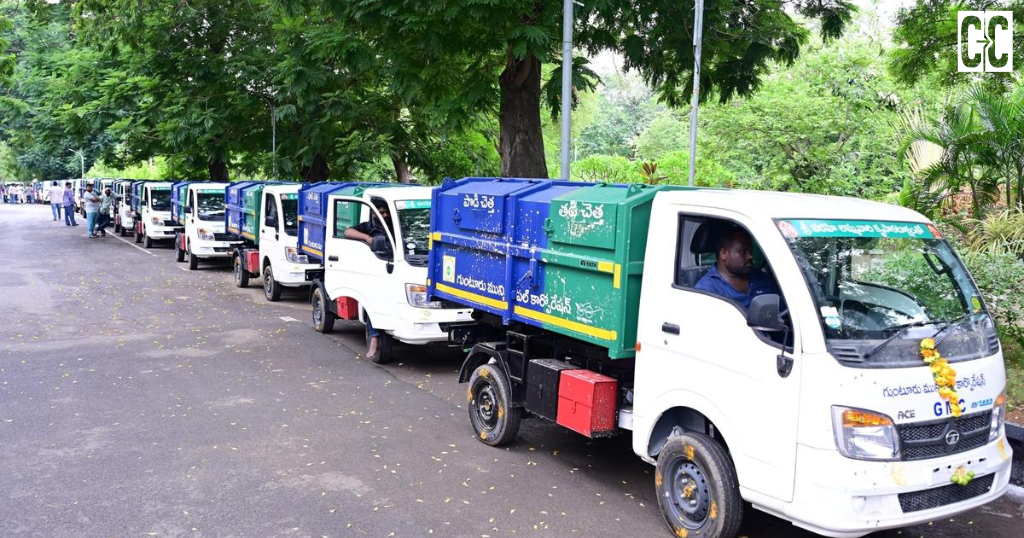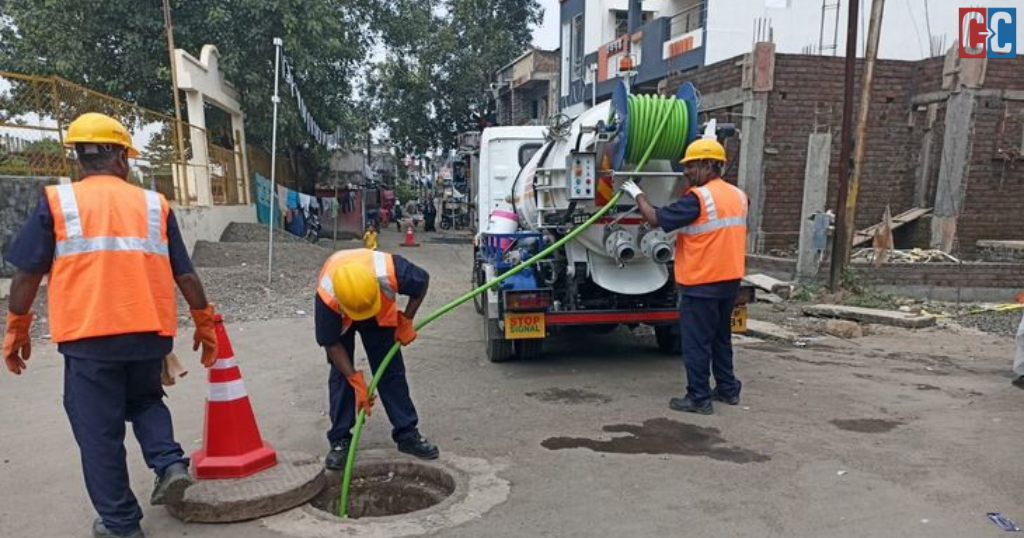

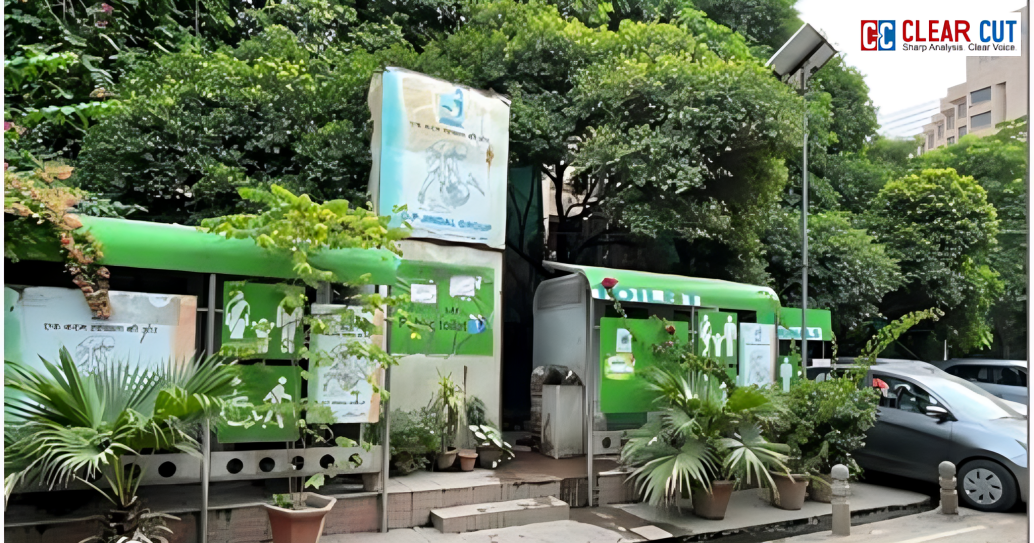
India’s urban sanitation has shifted from building infrastructure to performance-based governance under Swachh Bharat Mission (Urban) 2.0, using assessments and certifications to ensure accountability. While this improves monitoring and outcomes, challenges like inequality, sustainability, and long-term service delivery still persist.
Over the past ten years, India’s urban sanitation system has experienced a dramatic shift from a narrow concentration on infrastructure availability to a broader emphasis on performance, accountability, and
quantifiable outcomes. Cleanliness is increasingly viewed as a governance parameter influenced by certifications, indicators, and third-party evaluations rather than just a public health goal. This article analyses how national sanitation frameworks have institutionalised cleanliness through large-scale verification procedures and standardized protocols, under the Swachh Bharat Mission (Urban) and
especially its latter phase. It highlights the opportunities and conflicts inherent in assessment-driven sanitation governance, particularly with regard to equality, sustainability, and the day-to-day reality of providing urban services.
Introduction: From Swachh Bharat Mission (Urban) to SBM-U 2.0
One of India’s most significant urban governance initiatives was the Swachh Bharat Mission (Urban) [SBM-U]. It was introduced in 2014 with the goal of turning sanitation from a neglected municipal function into a national development priority. The three main goals of the mission were to achieve- 1) 100% Open Defecation Free (ODF) status, 2) Guaranteeing scientific solid waste management (SWM), 3) And promoting sustainable behaviour change through a Jan Andolan by October 2, 2019, across all statutory towns.
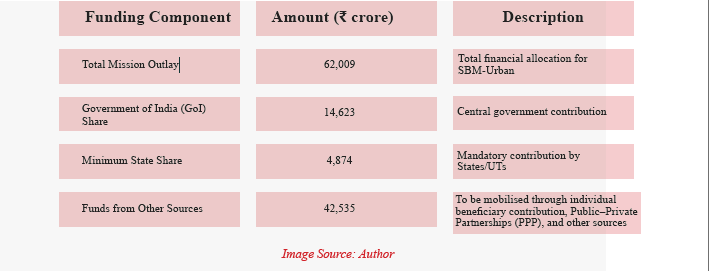
Significant results were achieved by SBM-U, particularly in waste management and access to sanitation.
According to official government records of SBM, by 2019, 4,371 of 4,372 Urban Local Bodies had been
designated ODF, thanks to the building of 6.40 lakh seats in community and public restrooms and 66.86
lakh individual family restrooms. Additionally, the data recorded that in solid waste management, doorto-
door garbage collection reached 97% of urban wards, source segregation reached 85%, and treatment
capacity rose from 26,000 tonnes per day (18%) in 2014 to approximately 1 lakh TPD (70%). Notably,
more than 90,000 unorganised waste workers were integrated into official waste management systems,
enhancing employment prospects, particularly for urban poor women.
Despite these successes, independent evaluations by NSSO (2018) and NITI Aayog (2021) revealed enduring issues, including the need for long-term behavioural change, legacy dumpsites, insufficient treatment of faecal sludge, and the management of plastic and construction debris. These results demonstrated that sanitation systems were unequal, environmentally vulnerable, and capacity-constrained even though access targets had been mostly met.
To institutionalise achievements and cover the full sanitation value chain, the Mission was expanded as Swachh Bharat Mission (Urban) 2.0 (2021– 2026). The goal of a Garbage-Free Urban India, which includes the safe containment and treatment of wastewater and faeces, the cleanup of legacy waste, the reduction of single- use plastics, and increased public participation, is given top priority in SBM-U 2.0. SBM-U 2.0 represents a significant shift in India’s urban policy framework, aligning with SDG 6 and SDG 11, from symbolic cleanliness to systems-based, sustainable urban sanitation.
Third-Party Assessments and Standardised Protocols
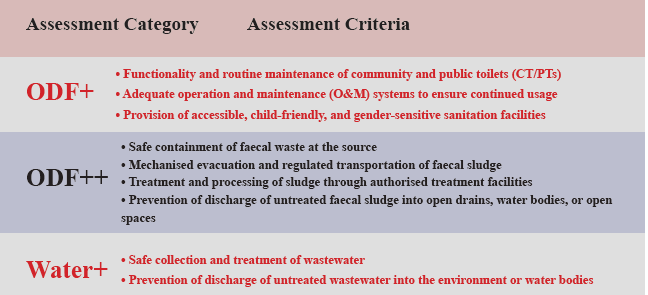
The Ministry of Housing and Urban Affairs (MoHUA) has established standardised sanitation procedures
that are assessed by impartial third parties to maintain an Open Defecation Free (ODF) status and prevent
slippage. Beyond the provision of infrastructure, these guidelines establish precise evaluation criteria
to measure sanitation outcomes. According to the standardised protocols, assessment criteria
consist of as given in the table.

SBM ODF+ and ODF++ Certification Toolkit and Protocol
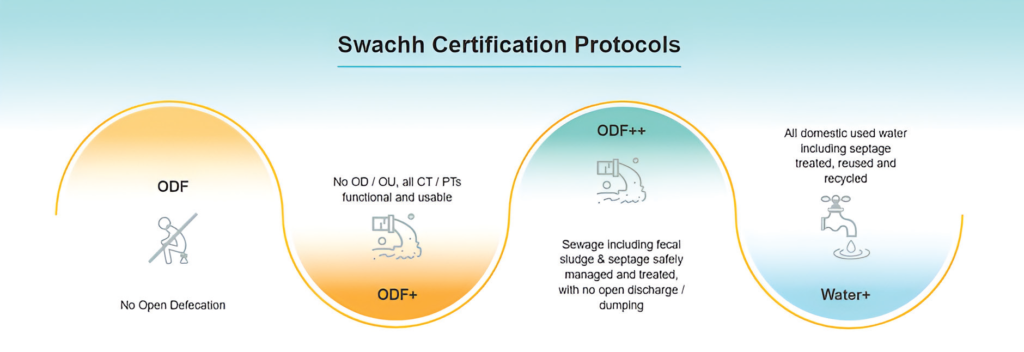
The Ministry of Housing and Urban Affairs (MoHUA) released a comprehensive toolkit and official
protocol for Indian cities seeking to progress from Open Defecation Free (ODF) status to the more rigorous SBM ODF+ and SBM ODF++ certifications. It establishes clear definitions and mandatory infrastructure requirements, focusing on the functionality and cleanliness of public toilets for ODF+ and advanced waste management for ODF++. Under the SBM ODF++ criteria, Urban Local Bodies must demonstrate the safe containment, transport, and treatment of all faecal sludge and sewage. The toolkit outlines a rigorous declaration process involving various stakeholders, including schools, self-help groups, and local representatives. Verification is conducted through third-party inspections, including surprise audits and geo-tagged physical observations, to ensure long-term sustainability and reliability. These
protocols aim to shift the national focus from merely building toilets to achieving holistic and sustainable
urban sanitation for all citizens.
Coverage of Swachh Certification (SBM–Urban Dashboard, 2025)
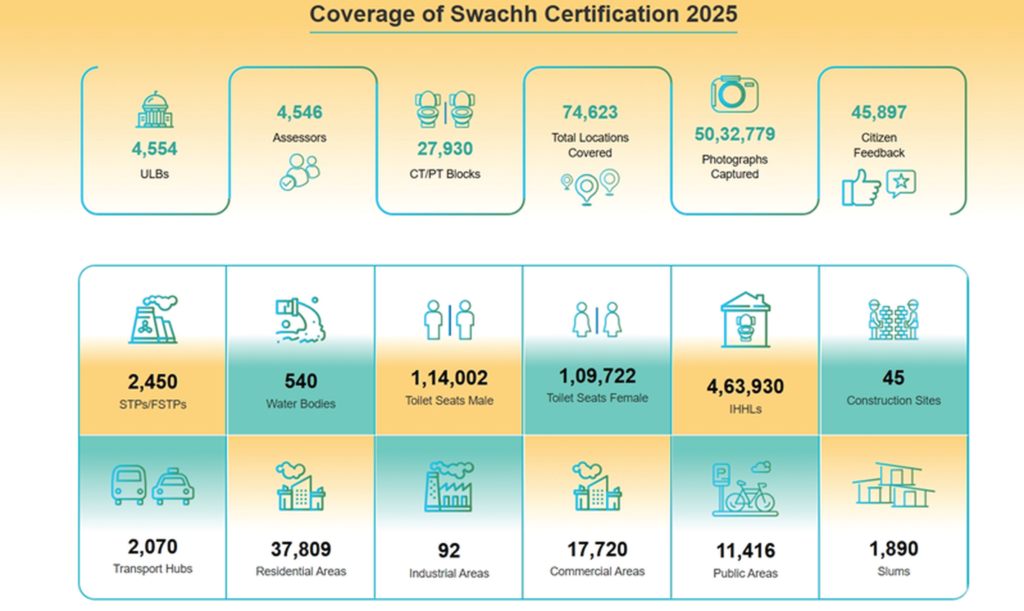
The Swachh Bharat Mission (Urban) dashboard data for 2025 highlights the scale, intensity, and spatial spread of sanitation assessments carried out across Indian cities as part of certification processes such as ODF+, ODF++, Water+, and Garbage-Free City ratings.
At the institutional level, sanitation assessments covered 4,554 Urban Local Bodies (ULBs) nationwide. These assessments were conducted by 4,546 trained assessors, indicating near one-to-one deployment for field verification. In total, 74,623 locations were physically assessed, underscoring the Mission’s emphasis on on-ground validation rather than desk-based reporting.
A significant focus of the assessments was on community and public sanitation infrastructure, with 27,930 community and public toilet (CT/PT) blocks evaluated. To strengthen transparency and evidence-based verification, assessors captured over 5 million geo-tagged photographs, which form a critical component of third-party assessment protocols under SBM-U. For this MoHUA partnered with Google to map all public toilets on Google maps, thereby improving ease of access of sanitation facilities to citizens.
Till date, 2,300 cities have uploaded more than 57, 000 PTs mapped on Google maps, covering more than 50% of India’s urban population (PIB, 2019). Additionally, 45,897 instances of citizen feedback were recorded, reflecting an effort to incorporate public perception and user experience into sanitation certification outcomes.
The dashboard further disaggregates coverage by infrastructure type and urban space, revealing the breadth of SBM-U monitoring. Assessments included 2,450 sewage treatment plants (STPs) and faecal sludge treatment plants (FSTPs) and 540 water bodies, highlighting the Mission’s growing focus on wastewater management and environmental protection—key elements of ODF++ and Water+ protocols.
Sanitation access was assessed across gender dimensions, covering 1,14,002 male toilet seats and 1,09,722 female toilet seats, pointing to an attempt at gender-sensitive infrastructure monitoring. Household-level sanitation was also a major component, with 4,63,930 Individual Household Latrines (IHHLs) assessed.
Beyond residential areas, SBM-U assessments extended into diverse urban spaces that are critical for public health and service delivery. These included 2,070 transport hubs, 37,809 residential areas, 17,720 commercial areas, 92 industrial areas, and 11,416 public spaces. Importantly, 1,890 slum areas were also assessed, signalling an effort—at least in monitoring terms—to include informal settlements within the sanitation governance framework. Overall, the dashboard data reflects SBM-Urban’s transition from a construction-driven mission to a verification-intensive, outcome-oriented sanitation programme. The breadth of coverage illustrates the ambition of certification protocols like ODF++ to standardise sanitation outcomes across varied urban contexts, while also leaving data gaps in the assessments.
Conclusion: Assessment-Led Sanitation and Its Limits
The transition of SBM (Urban) from an infrastructure-driven program to an assessment-intensive governance framework is indicative of a larger change in India’s conception and management of urban sanitation. Cleanliness has been institutionalized as a quantifiable and auditable outcome through standardized procedures, third-party verification, and data-rich dashboards; ODF++, Water+, and Garbage-Free certifications serve as important policy tools. This architecture has improved accountability,
made it possible to compare cities, and highlighted the entire sanitation value chain, including
wastewater and fecal sludge management. But there are also serious issues with the reliance on certification and recurring evaluations. While structural disparities— particularly in informal settlements
and among sanitation workers— remain largely unaddressed, the performative logic of rankings and labels runs the risk of favoring compliance over long-term service excellence. Furthermore, ongoing
operations, funding, and institutional ability at the local level are more important for maintaining ODF++
results than one-time verification. The difficulty as SBM-U 2.0 develops is to make sure that assessment
regimes continue to be instruments for development rather than ends in and of themselves, integrating
sanitation governance into regular urban service delivery as opposed to sporadic certification exercises.
Clear Cut WASH Desk
New Delhi, UPDATED: March 22, 2026 9:00 IST
Written By: Nidhi Chandrikapure