
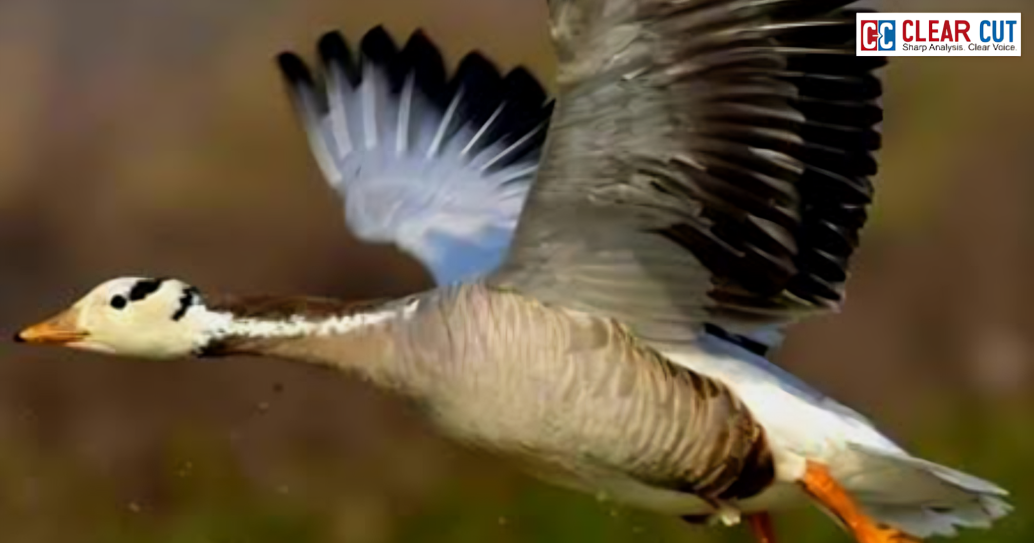
- Shekha Jheel in Aligarh was declared India’s 99th Ramsar site after becoming a critical habitat for migratory birds like the bar-headed geese and supporting rich wetland biodiversity.
- Located on the Central Asian Flyway, the wetland hosts 249 bird species and threatened freshwater turtles, making it ecologically significant for both India and global bird migration routes.
- The article argues that Ramsar recognition must lead to stronger conservation measures against urbanisation, pollution, and wetland degradation to protect these fragile ecosystems long-term.
The Geese that flew eleven thousand kilometres to find this lake
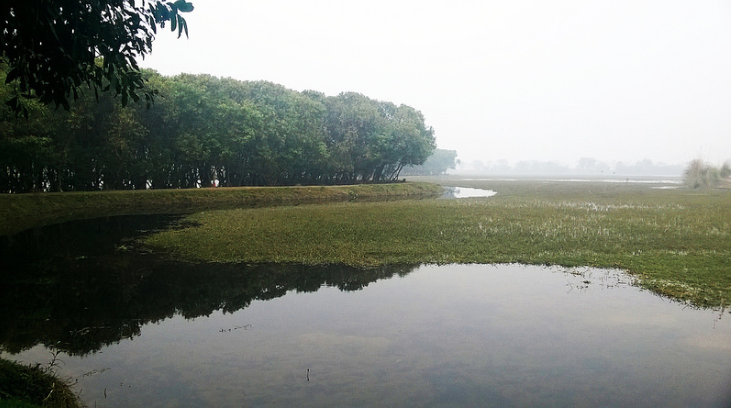
Every winter, bar-headed geese make one of the most extraordinary journeys in the animal kingdom. It is a non-stop, high-altitude crossing of the Himalayas from their breeding grounds in Central Asia to their wintering sites in the Indian subcontinent. They fly at altitudes that would render most birds unconscious. They navigate by magnetic field, by star position, by memory. And for many of them, the journey ends at a freshwater lake in Aligarh, Uttar Pradesh. It is a partially human-made wetland formed in the 1852 when the Upper Ganges Canal was built through the region. The lake the geese found, Shekha Jheel, was designated India’s 99th Ramsar site on April 22, 2026.
The announcement was made by Union Minister for Environment, Forest and Climate Change, Bhupender Yadav, who noted that the designation ‘brings a boost for local livelihoods and global biodiversity, along with water and climate security’ and marks India’s 99th, bringing us closer to a historic century. Uttar Pradesh, with 12 Ramsar sites, now holds more internationally designated wetlands than any other Indian state.
What makes the Shekha Jheel Significant
Shekha Jheel: 249 bird species recorded, 62 wetlands dependent. Three threatened turtle species. Crucial stopover on the Central Asian Flyway. India now has 99 Ramsar sites covering 1,384,181 hectares.
PIB / Ramsar Convention / Manorama Yearbook 2026
Shekha Jheel is not a pristine natural lake. It is a partially human-made wetland complex, formed by the interaction of the Upper Ganges Canal (constructed in the 1850s) with the surrounding low-lying terrain. The transition between open water and adjacent deciduous forest has created ecological niches of exceptional biodiversity. BirdLife International has appointed it an Important Bird and Biodiversity Area. Researchers have recorded 249 bird species, of which 62 are wetland dependent. Notable species include the vulnerable Indian River Tern and the Sarus Crane, the world’s tallest flying bird.
Three threatened freshwater turtle species inhabit the lake: the Black Pond Turtle, the Indian Flap-Shelled Turtle, and a third species documented in recent ecological surveys. The lake sits directly on the Central Asian Flyway, which is a migratory corridor that connects breeding grounds in Siberia with wintering sites across South Asia, used by millions of birds every year. Disrupting or degrading Shekha Jheel does not affect only Aligarh. It affects the entire flyway.
The race against the concrete
India’s Ramsar designation record 72 new sites added since 2014, including 28 in 2022 alone during the 75th Independence year. This is a genuine conservation achievement. But Ramsar designation is not development prohibition. It is a framework for sustainable use and conservation planning. The real test of India’s 99-site commitment is whether the ecological character of these wetlands is maintained after the announcement photograph.
India’s wetlands face overlapping threats: agricultural runoff and pesticide contamination, urban encroachment as cities expand, groundwater extraction that lowers water tables, and the absence of buffer zone enforcement around protected areas. Delhi, the national capital, is home to over 1,000 waterbodies but has not a single Ramsar-designated wetland. Sanjay Lake, Bhalswa Lake, and Tikri Khurd lake are ecologically significant and severely threatened. Their absence from India’s Ramsar list is not a reflection of their ecological value. It is a reflection of land development pressure in a city that has consistently chosen construction over conservation.
What The 99th Site Must Trigger
The designation of Shekha Jheel must be the beginning of a protection programme, not its endpoint. The Ministry of Environment must publish a state-by-state wetland degradation index annually, mapping the ecological health of existing Ramsar sites against their designation baseline. Urban wetlands in Tier-1 cities must be brought under mandatory ecological assessment before any land use change is approved within 500 metres of their boundaries. And the community fisher folk and birdwatchers who have informally protected Shekha Jheel for decades must be formally recognised as conservation partners, with documented rights to livelihood activities that are compatible with wetland ecological health.
The bar-headed geese will return to Shekha Jheel next winter. They ask for nothing but a clean lake and enough fish. India’s 99th Ramsar site is a promise to provide exactly that.
Conclusion?
References
1. PIB / MoEFCC. (2026, April 22). Shri Bhupender Yadav Announces Shekha Jheel Bird Sanctuary as India’s 99th Ramsar Site. pib.gov.in/PressReleasePage.aspx?PRID=2254357
2. Manorama Yearbook. (2026). Aligarh’s Shekha Jheel Bird Sanctuary Gets Ramsar Site Tag. manoramayearbook.in
3. DD News. (2026, April 22). Shekha Jheel Declared India’s 99th Ramsar Site, UP’s Tally Rises to 12. ddnews.gov.in
4. The Print. (2026, April 22). Shekha Jheel Bird Sanctuary in Aligarh Becomes India’s 99th Ramsar Wetland Site. theprint.in
5. Ramsar Convention. (2026). Ramsar Sites Information Service: India Country Data. ramsar.org
6. BirdLife International. Shekha Jheel: Important Bird and Biodiversity Area (IBA) Designation. datazone.birdlife.org
Clear Cut Climate, Research Desk
New Delhi, UPDATED: May 16, 2026 05:30 IST
Written By: Janmojaya Barik