


- India’s health budget has increased significantly, with major investments in Ayushman Bharat, health infrastructure, digital health, and medical education to expand healthcare access and capacity.
- Despite higher spending, non-communicable diseases now account for 57% of deaths, while health spending as a share of GDP and the Union Budget has declined.
- The article argues that future health investments must focus on prevention, primary healthcare, accountability, and equitable access to ensure meaningful improvements for all citizens.
The Ledger of Progress and Its Hidden Deficit
There is a number that should prompt reflection before celebration. India’s Ministry of Health and Family Welfare received an allocation of ₹1,06,530.42 crore in Union Budget 2026-27. This was a 10% increase over the revised estimates of FY 2025-26 and a cumulative 194% growth over 12 years since 2014-15. The Department of Health Research was allocated ₹4,821.21 crore, up 24%. By any absolute measure, India is spending more on health than at any point in its post-independence history.
And yet. India’s life expectancy rose from 49.7 years in 1973 to 70.3 years in 2023. This is a genuine public health achievement. But the Economic Survey 2025-26 documents a simultaneous crisis of non-communicable disease. They now account for 57% of all deaths in India. Cardiovascular disease, diabetes, cancer, and obesity are rising fastest among populations that cannot afford the care those diseases demand.
What the Money Is Buying
The PM-JAY (Ayushman Bharat) received ₹9,500 crore (up 5.56%), covering hospitalisation for over 55 crore beneficiaries. The National Health Mission received ₹39,390 crore (up 6.17%), anchoring primary and maternal healthcare delivery. PM-ABHIM surged by 67.66% to ₹4,770 crore, focused on critical care blocks and integrated public health labs. The Ayushman Bharat Digital Mission received ₹350 crore and the SHAKTI biopharma initiative carries an outlay of ₹10,000 crore over five years to position India as a global biologics and biosimilars manufacturing hub.
5 Regional Medical Hubs, integrating treatment, research, education, and wellness services, have been proposed. Medical Value Travel, supported by e-Medical Visa access across 172 countries, contributes to a tourism sector that supports 8.46 crore jobs. MBBS seats and nursing seats have more than doubled since 2014. Postgraduate and super-specialty seats are up 100%.
The Numbers That Complicate the Narrative
Not all metrics trend upward. Health spending as a share of GDP fell from 0.37% in 2020-21 to 0.28% in 2026-27. Health’s share of the Union Budget declined from 2.26% to 2.07% over the same period. Programmes that address the social determinants of health like nutrition, primary care, public health promotion faced relative reductions. Meanwhile, the commercially structured schemes drew increased allocations. The National Health Mission which takes care of the frontline health delivery, received only a 6.17% increase against double-digit NCD burden growth.
India’s AMR burden is also acute. According to WHO GLASS 2025 data, 1 in 3 bacterial infections in India is resistant to common antibiotics. This is a crisis that requires surveillance investment, not just hospital beds.
The Accountability Compact
India cannot afford to treat health allocations as a communication exercise. Every crore allocated must produce a measurable output: beds commissioned, doctors trained, facilities operationalised, patients screened. The government must reinstate public reporting on out-of-pocket expenditure. This metric that more honestly reflects health system performance than headline budget numbers. NABH-accredited hospitals now exceed 1,299 facilities. But accreditation without geographic equity means urban quality and rural neglect coexist within the same national health mission.
The Vision That Must Be Insisted
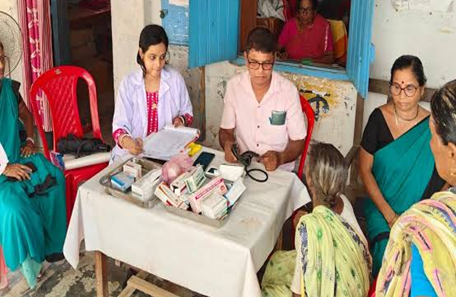
India at Viksit Bharat 2047 cannot be a nation of world-class hospitals for the middle class and overburdened primary centres for everyone else. Universal health coverage demands that NHM be funded at the scale the NCD burden demands. Digital health should reach the last ASHA worker, not just the metropolitan clinic. Prevention should receive the same policy urgency as treatment. The 194% growth in health spending is a foundation, not a finish line. The question for 2026 is whether the person in the village clinic feels the difference.
Clear Cut Health Desk
New Delhi, UPDATED: June 09, 2026 01:00 IST
Written By: Tanmay J Urs