
- Despite rising school enrollment rates, millions of children are progressing through grades without acquiring basic reading and comprehension skills, creating a hidden learning crisis.
- The problem is especially severe in low- and middle-income countries, where learning poverty has worsened after COVID-19, leaving many students unable to meet academic expectations.
- The article argues that education success should be measured by actual learning outcomes and foundational literacy, not just attendance, enrollment, or grade promotion.
Getting children into school has been the central obsession of education policy for as long as most of us can remember. And honestly, the world has pulled it off in ways that would have seemed impossible a few generations ago. Enrollment numbers have gone up, attendance is tracked, and governments have built schools in places that didn’t have them before. On the surface, it looks like progress.
The problem is what’s happening inside those schools, or more precisely, what isn’t.
Children are showing up. Sitting through lessons. Moving up grades year after year. And a staggering number of them are doing all of that without ever learning to read properly, sometimes without learning to read at all. The distance between being enrolled in school and acquiring knowledge has grown into one of the most pressing and least talked-about crises in education today.
The numbers alone should be enough to stop us in our tracks. Research carried out by the World Bank, UNESCO, and UNICEF found that in 2022, roughly 70 per cent of 10-year-olds in low- and middle-income countries could not read and make sense of a simple written passage. This figure is specifically measuring children who haven’t reached minimum reading proficiency by age ten, and before the COVID-19 pandemic hit, it was already at 57 per cent. The disruptions of the past few years didn’t manufacture this crisis. They made a pre-existing one dramatically worse.
These figures shifted from abstract to deeply personal for me when I conducted impact assessments, running remedial education programmes in government schools across several communities in South Delhi.
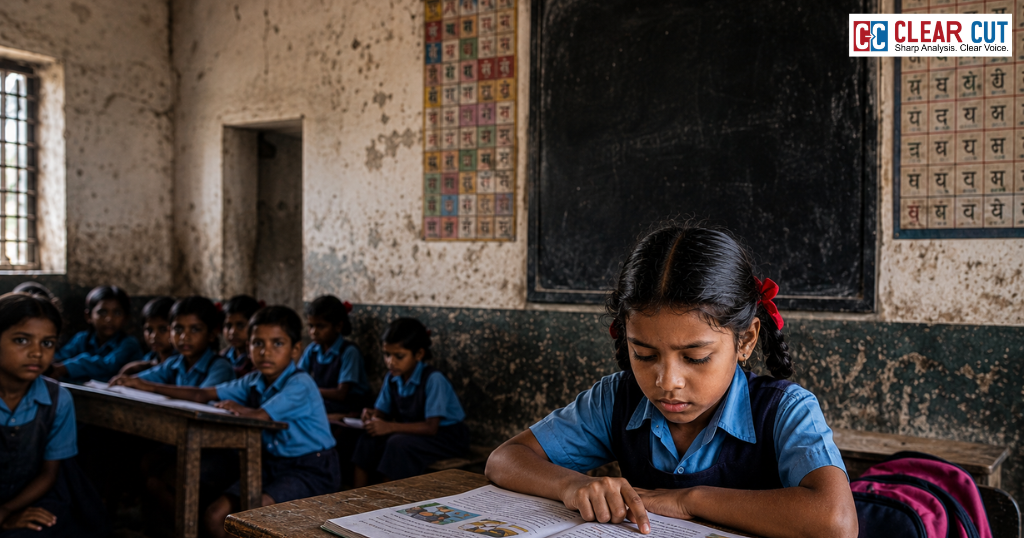
Students in Class 3, Class 4, or even Class 7 were unable to identify letters. Struggling with words that would be introduced in nursery. These were not children who had slipped through the cracks of enrollment; every single one of them was attending school, had reasonable attendance records, and had been promoted through the grades like clockwork. Many of them had received average marks in their school exams. Going in, I expected their assessments to reflect at least a basic command of foundational concepts. What I found instead were gaps that ran much deeper than their academic records suggested.
The thing that struck me most wasn’t just the gaps themselves; it was how invisible they had been. A child’s marks and grade level had, in many cases, said one thing entirely while their actual grasp of literacy said something else. Years of schooling had passed, and the skills that should have been the foundation for all of it simply hadn’t been built.
This matters in ways that compound over time. Reading isn’t one subject among many, it’s the mechanism through which a child accesses every subject. Mathematics, science, history, social studies, all of it eventually runs through the ability to read and comprehend. A child who hasn’t developed that ability isn’t just behind in literacy. They’re operating at a disadvantage across the entire curriculum, and as the academic content grows more demanding, the gap between where they are and where they’re expected to be only gets wider.
The conditions that produce this outcome are not difficult to identify. Classrooms packed far beyond what any single teacher can manage. Families stretched by financial pressure with little capacity to supplement learning at home. Homes without books or reading materials. Socio-economic circumstances that make educational engagement one priority competing against many others. Children from lower-income backgrounds, in particular, have dramatically fewer opportunities to encounter written language outside of school, which means school has to do far more of the work, and often doesn’t.
COVID-19 threw all of this into sharper relief. When schools closed, the structured environments that had at least been providing some scaffolding for literacy development disappeared entirely. The World Bank has been direct about this: those disruptions made learning poverty significantly worse, particularly for children who were already at a disadvantage before the closures began.
One of the things that emerged most clearly from my time doing fieldwork was how long this problem stays hidden. Children move through the early grades without anyone, or without sufficient mechanisms, catching that foundational skills were never secured. The deficit accumulates quietly. A child who couldn’t read at 7 becomes a child who couldn’t read at 9, and by the time they reach the upper primary or secondary years and the academic demands shift significantly, the gap has grown to a point where it’s genuinely hard to bridge.
Teachers and community workers described this trajectory in consistent terms. Students who had made their way through elementary school without mastering basic reading and comprehension would arrive in higher grades and find themselves unable to cope with what was being asked of them. For some, that eventually meant walking away from school entirely. Dropout in adolescence is shaped by many things: financial need, family circumstances, social pressures; but the experience of being unable to meet academic expectations after years of falling further behind is, by all accounts, a significant factor for many of these students.
Grade promotion without mastery doesn’t resolve the problem. It relocates it. The failure gets deferred, not prevented, and when it surfaces, as it eventually does, it surfaces at a stage where recovery is much harder, and the consequences are much more serious.
Enrollment figures and grade progression rates create the impression that children are moving successfully through the education system. In many cases, they are not. They are moving through the system while the system fails to ensure they’re actually learning anything. That distinction matters enormously, and education policy has been too slow to treat it as the central concern it deserves to be.
School was always meant to be a means to an end; the end being a child who can read, think, understand, and participate fully in the world. When attendance and enrollment become the measure of success rather than actual learning, we’ve lost track of what the whole enterprise was for. Getting children through the doors was never the goal. What happens once they’re inside is.
Clear Cut Education, Research Desk
New Delhi, UPDATED: June 12, 2026 01:00 IST
Written By: Zaina Azfar