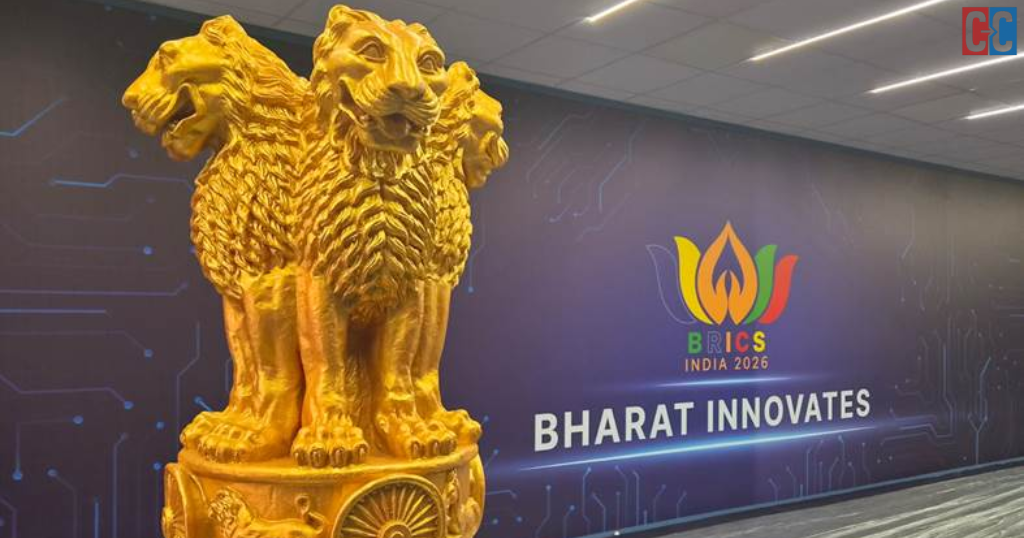


- India’s AI Governance Guidelines 2026 introduce a seven-principle framework to ensure responsible, safe, and inclusive AI development while establishing institutions for oversight and accountability.
- The launch of BharatGen, India’s first government-funded multilingual AI model supporting 22 Indian languages, aims to make AI accessible across sectors such as healthcare, education, agriculture, and governance.
- Through a phased rollout and strong focus on AI safety, transparency, and digital sovereignty, India is seeking to balance technological innovation with effective regulation.
THE QUESTION NOBODY WANTED TO SKIP
Nations building AI capability generally face a political temptation: deploy first, govern later. The history of technology regulation suggests that temptation is almost always acted upon. India, in early 2026, chose a different path. The release of the India AI Governance Guidelines was anchored in 7 guiding principles and presented at the AI Impact Summit in February 2026. It clearly signalled that India intends to build guardrails at the same pace as it builds capability.
This is not a small ambition. By June 2026, the BharatGen AI platform was launched at the BharatGen Summit on June 2, 2025. It had established India’s first government-funded, homegrown multimodal large language model, supported 22 Indian languages and integrating text, speech and image understanding. The platform was built on domestic datasets and is available as a common infrastructure for startups and researchers.
| 22 Indian Languages Supported | 7 Sutras AI Governance Principles | 2.23 Lakh Startups Recognised (Mar 26) | Feb 2026 AI Strategy Launch |
THE ARCHITECTURE OF THE GUIDELINES
The India AI Governance Guidelines adopt what they describe as a principle-based, techno-legal approach. The framework establishes new institutional bodies such as the AI Governance Group, the Technology and Policy Expert Committee, and the AI Safety Institute. This is a whole-of-government model and not a single ministry’s mandate. It follows a cross-departmental architecture acknowledging that AI cuts across agriculture, health, education, national security and financial services simultaneously.

The Ministry of Electronics and Information Technology (MeitY) constituted the drafting committee in July 2025, with the guidelines released 7 months later. The rollout follows a 4-phase timeline: institutional setup and governance design through 2026-27, pilot programmes in high-readiness sectors from 2027-29, and nationwide rollout from 2029 onward. The sequencing reflects a degree of policy humility that large digital deployments in India have not always demonstrated.
BHARATGEN: SOVEREIGNTY IN THE STACK
The decision to invest in an indigenous large language model is significant beyond its technical specifications. BharatGen’s 22-language architecture addresses something no imported model can: the lived linguistic reality of India. For farmer in Nagaland seeking crop disease advice, a student in Manipur asking a science question, a health worker in Chhattisgarh recording a patient history; the value of AI is zero, if the interface language is not their own.
The government’s stated objective is to ensure AI is diffused across agriculture, healthcare, education, governance, manufacturing, and climate action and not concentrated in metropolitan tech corridors. The Anusandhan National Research Foundation (ANRF) is positioned as the funding vehicle for AI research at scale.
THE WORK THAT GOVERNANCE CANNOT AVOID
Governance frameworks for AI face a specific credibility problem: they are written by people who understand regulation, about technologies they cannot fully anticipate. India’s framework is stronger for being principle-based rather than prescriptive. It creates institutional capacity for adaptive response rather than locking in rules that will be obsolete in 3 years.
But principles without enforcement are intentions. The AI Safety Institute must publish annual transparency reports on high-risk AI deployments by public bodies. The AI Pitch Fest (UDAAN) must graduate from a 1-time summit event to a funded, tracked, multi-year programme. And BharatGen’s datasets must be audited for representational equity: if the 22 languages are unevenly trained, the last mile the government claims to care about will be served worst.
Clear Cut Startups Desk
New Delhi, UPDATED: June 11, 2026 05:00 IST
Written By: Tanmay URS