


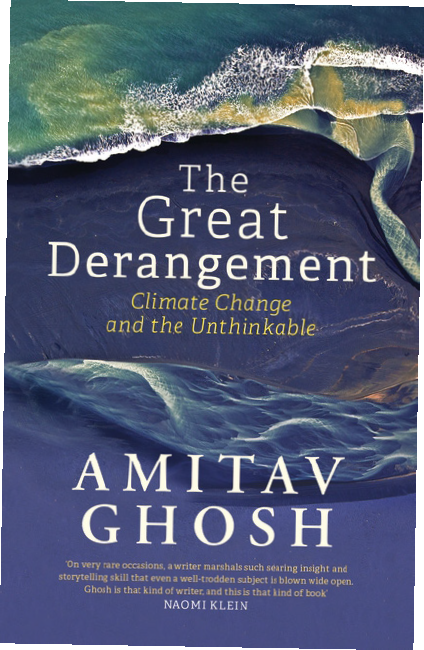
- Amitav Ghosh’s The Great Derangement argues that modern literature, culture, and politics are fundamentally ill-equipped to understand and respond to climate change.
- The book explores how the conventions of the modern novel and the frameworks of liberal democracy fail to capture the scale, urgency, and complexity of the climate crisis.
- Ghosh calls for a deeper reimagining of how societies think, tell stories, and govern in an era of planetary disruption.
Amitav Ghosh never set out to write a polemic with The Great Derangement. The book started life as the Berlin Family Lectures at the University of Chicago, and you can still feel that origin in its final form: it’s restless, essayistic, and willing to chase an argument wherever it leads. Ghosh roams across literary criticism, history, postcolonial theory, and political philosophy, but he never drops his central question. It’s a simple claim, almost unsettling in its clarity: our culture and politics aren’t just failing to grapple with climate change but they’re fundamentally incapable of doing so. This incapacity isn’t some communication glitch or a matter of weak political will. It’s baked into the very ways modern societies think and tell stories about themselves. That’s a big assertion. Ghosh builds his case methodically, but with a confidence that makes the book short as it is, worth reading slowly, maybe more than once.
Stories: The Failure of the Novel
The first section, “Stories,” is probably the most innovative and provocative part of the book. Ghosh begins by reflecting on his own difficulty, as a novelist, in weaving climate change into serious literary fiction. This isn’t just a technical hurdle. The problem, he argues, is structural, climate change defies the core conventions of the modern novel. Since the eighteenth century, the “serious” Anglo- American novel has focused on the individual on their consciousness, moral growth, and relationships, played out in a familiar, believable world. The novel prefers the probable, the plausible, and what Ghosh calls “the regularity of bourgeois life.” It’s about events that could, in principle, happen to someone like us, in a life we recognize.
Climate change upends all this. It unfolds on timescales and spatial scales that dwarf human experience. Its most vivid signs such as floods, cyclones, wildfires are rare and extreme, unlikely in any single life but inevitable in aggregate. For the novel, these events fall into the territory of melodrama, not realism. Even when novels do feature climate disasters, they get shunted into genre fiction, labeled dystopian or thriller not serious art. The traditional literary novel so in love with interiority and realism simply can’t take in
the scale or improbability of the planetary crisis without scrambling its basic form.
Ghosh isn’t just describing a literary phenomenon; he’s diagnosing a problem. He points out how the novel and carbon capitalism grew together. The realism of the 19th- and 20th-century novel reflects a worldview where nature is a stable backdrop, the individual stands at the center, and the present flows neatly into the future. But the Anthropocene, this era of planetary disruption destroys those assumptions. The cultural “derangement” Ghosh writes about is a collective failure of the imagination, and that kind of failure keeps us from acting.
Politics: The Inadequacy of Liberal Rationalism
The third section, “Politics,” is both the most pessimistic and the boldest. Here, Ghosh goes after the core frameworks of liberal democracy, cost-benefit analysis, policy tweaks, rational negotiations between self-interested states and calls them structurally inadequate for the climate crisis.
These approaches assume a normal timeline, familiar costs and benefits, and a cast of actors who can speak and be heard. Climate change blows apart these assumptions. Its timescales outstrip election cycles. Its impacts are scattered across distant generations and nonhuman life, none of whom get a vote. Standard economic tools just erase these costs, or discount them into virtual oblivion.
Ghosh’s most striking move is to argue that secular liberal rationalism might not hold the answers we need. Instead, he points to social movements and religious traditions such as Laudato Si (Pope Francis’s 2015 encyclical on ecology and human responsibility) from the Catholic Church, Indigenous frameworks that tie ecology and cosmology together, mass movements that win change through passion and moral force rather than technocratic policy as these, he suggests, might offer models for real political mobilization. It’s a challenge to conventional wisdom, and Ghosh doesn’t fully map out what would follow, but his intellectual honesty is bracing. He’s not prescribing solutions; he’s diagnosing the structural obstacles in our current politics.
Assessment
Nearly a decade after publication, The Great Derangement feels less like a provocation than an analysis that time keeps vindicating. The literary novel still shies away from climate change or when it addresses it, the work gets slotted as genre. International. agreements, like the Paris deal, have yet to generate emissions reductions at the scale promised. And the injustices Ghosh details have only grown more visible as the world’s most vulnerable bear the brunt of disasters they didn’t cause.
The limits don’t undermine the achievement. The Great Derangement stands as the clearest, most intellectually serious account of why our cultural and political systems keep missing the scale and urgency of climate change. The problem, Ghosh insists, isn’t just one of information or will. It’s woven into how we think, how we write, and how we govern. A decade later, this insight hasn’t been dislodged, it’s been confirmed over and over.
If you work on environment and climate whether in policy, advocacy, corporate sustainability, or research, this is essential reading. It won’t hand you solutions, but it will help you understand why the standard approaches fall short, and why a deeper reimagining is overdue. Ghosh’s sharp and graceful analysis draws the true contours of our impasse. This is a book for policymakers, sustainability and ESG practitioners, climate governance researchers, and anyone trying to bridge the worlds of culture and environmental.
Clear Cut Climate Desk
New Delhi, UPDATED: June 23, 2026 02:45 IST
Written By: Janmojaya Barik