
- Sumant Sinha founded ReNew Energy in 2011 and transformed it into one of India’s largest renewable energy companies, helping drive the country’s clean energy transition through solar, wind, and energy storage projects.
- With an 18.5 GW portfolio and major investments in solar manufacturing and battery storage, ReNew has become a key player in India’s goal of achieving 500 GW of non-fossil fuel capacity by 2030.
- While ReNew’s growth and climate impact are widely recognized, the company faces ongoing expectations to ensure transparent community engagement, environmental accountability, and equitable benefits for local populations.
The Bet Nobody in Indian Finance Wanted to Take
In 2011, when Sumant Sinha left his position as Chief Financial Officer of the Aditya Birla Group’s renewable energy business to found his own company, the Indian renewable energy sector was not yet the story it would become. Installed solar capacity in India at that point was negligible. Wind was modest. The sector was fragmented, regulatory frameworks were unstable, and the consensus in Indian corporate finance was that renewable energy was a government project, not a private enterprise opportunity.
Sinha saw it differently. He had IIT Delhi for engineering, IIM Calcutta for management, and Columbia University’s School of International and Public Affairs for policy. He also had a career in investment banking with Citicorp Securities and ING Barings that had taught him how capital flows toward clarity. A combination that made him fluent in the three languages India’s energy reform actually requires: technical, financial, and political.
What he believed, and what ReNew Energy Global was built to prove, was that renewable energy in India was a commercial opportunity of historic scale, not a charity sector dressed in solar panels.
He was right. And the proof is now 18.5 gigawatts wide.
Sumant Sinha turned a risky clean-energy gamble into one of India’s biggest renewable success stories—reshaping the nation’s energy future, one gigawatt at a time.
The Company and Its Numbers
As of March 31, 2025, ReNew’s portfolio stands at approximately 18.5 GW, including projects under development and in the pipeline. Commissioned capacity stands at approximately 10 GW, making ReNew one of India’s largest renewable energy producers and one of the fastest clean energy companies globally to reach the 10 GW milestone. [ReNew Annual Integrated Report FY 2024-25 / ReNew.com]
ReNew’s renewable energy assets now account for approximately 10% of India’s total solar and wind power generation. The company’s projects power around 6 million homes in India and are estimated to reduce approximately 0.5% of India’s total carbon emissions. [ReNew Annual Integrated Report FY 2024-25 / Business Wire, November 2024]
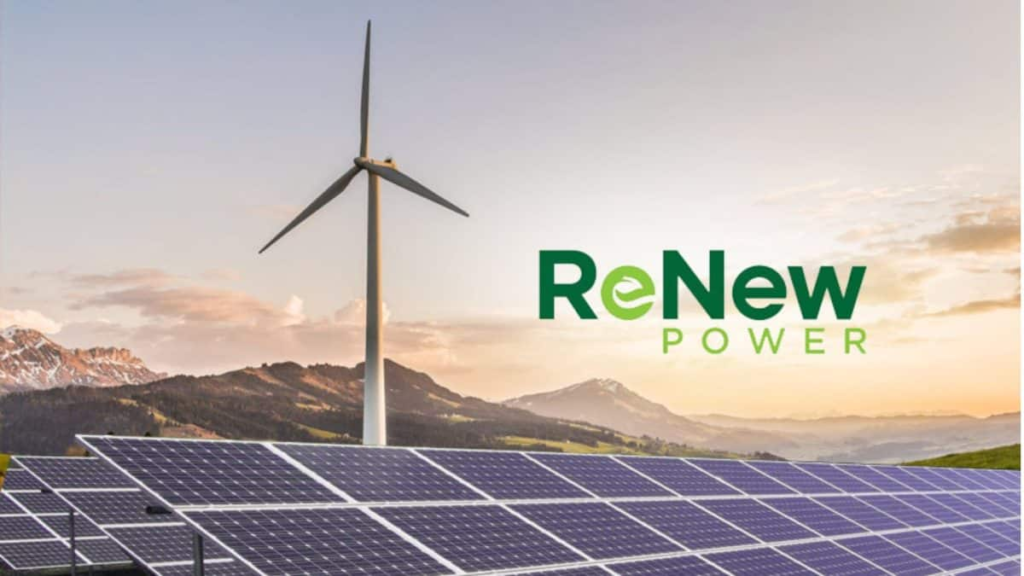
The company operates across more than 150 utility-scale projects. Its portfolio spans solar, wind, hydro, hybrid projects, and increasingly, battery energy storage systems — the technology that converts intermittent renewable generation into firm, dispatchable power. It is listed on the NASDAQ stock exchange, making it one of the first Indian renewable energy companies to access international public capital markets.
India added 33 GW of electricity capacity in FY 2024-25, with approximately 90% from renewables. To meet its 2030 target of 500 GW non-fossil fuel capacity, India requires an estimated USD 80–100 billion in annual investment. ReNew FY25 Annual Report / India CSR 2025
The Manufacturing Bet
In FY 2024-25, ReNew’s solar manufacturing plants in Jaipur and Dholera reached a combined module capacity of 6.4 GW and cell capacity of 2.5 GW, making them fully operational and contributing to ReNew’s profitability. [ReNew Annual Integrated Report FY 2024-25]
The manufacturing push is strategic and politically significant. India has committed under its Production Linked Incentive (PLI) scheme to build a domestic solar manufacturing ecosystem to reduce dependence on Chinese imports. ReNew’s manufacturing scale positions it as a domestic supplier to India’s growing project pipeline while also creating an export opportunity, now supplying solar modules to markets in Southeast Asia, Africa, and Europe.
ReNew also pioneered India’s first utility-scale Battery Energy Storage System (BESS), executing a 150 MWh project in Karnataka. The company’s 1.3 GWp solar farm at Pokhran, Rajasthan — India’s largest single-location solar project — was inaugurated in FY 2024-25. [ReNew Annual Integrated Report FY 2024-25 / India CSR 2025]
The Recognition That Followed the Results
TIME included Sumant Sinha on its 2024 TIME100 Most Influential Climate Leaders list, recognising his role in progressing India’s clean energy transition and contributing to the global shift to a low-carbon economy. [TIME100 Climate 2024 / Business Wire, November 2024]
In 2025, Sinha was named to Forbes’ Global Sustainability Leaders list. He has also received the 2022 USISPF Global Leadership Award, the Economic Times Entrepreneur of the Year 2018, and the EY Entrepreneur of the Year 2017. He is described as the first Indian business leader to be recognised as an SDG Pioneer by the United Nations. [ReNew Leadership Profile]
At the World Economic Forum, Sinha co-chairs the Alliance of CEO Climate Leaders, described as the largest CEO-led alliance on climate action globally. In 2025, he was appointed Chair of the CII Energy Transition and Hydrogen Council. He is a Fellow of the Indian National Academy of Engineering and a board member at IIT Delhi. He authored Fossil Free: Reimagining Clean Energy in a Carbon-Constrained World, a book that lays out his argument for why India’s clean energy transition is economically inevitable, not merely environmentally desirable.
What The Gigwatts Don’t Tell You
ReNew’s record is exceptional. But the company operates in a sector with genuine accountability challenges that honest journalism requires acknowledging. Large-scale solar and wind projects require significant land. Land acquisition processes in India have documented histories of displacing communities, particularly in states where land rights for tribal and agricultural communities are inadequately protected.
ReNew has published its first Nature Risk Report for FY 2024-25, fully aligned with the Taskforce on Nature-related Financial Disclosures (TNFD)’s 14 recommendations. The report signals awareness of ecological impact beyond carbon metrics. [ReNew.com, Nature Risk Report 2024-25]
The company’s social impact programmes report reaching over one million lives. These claims require the same rigour that is applied to energy output claims — verified, independently assessed, and tied to specific, named communities and measurable outcomes. The ESG architecture that ReNew has built is more sophisticated than most Indian companies of any sector. It is not yet at the standard that a company with its international profile and capital market exposure should be held to.
India’s Energy Crossroads and the Role of Leaders Like Sinha
India’s electricity demand is projected to grow 6.3% annually, with total consumption expected to double over the next seven years. Sumant Sinha has stated publicly that 70–80% of that increased demand will be met by renewable energy. [ANI / The Print, December 2024] ReNew was the first Indian electric utility to be featured in the S&P Global Sustainability Yearbook 2025, and has been ranked among the top seven renewable power companies globally by Morningstar Sustainalytics. [ReNew Annual Integrated Report FY 2024-25]
At stake in India’s energy transition is not only a climate target. It is the economic model of the next fifty years. A country that builds its energy system on renewables, domestic manufacturing, and storage technology will look very different from one that remains dependent on imported fossil fuels. ReNew, under Sinha’s leadership, has demonstrated that the private sector can be the velocity in that transition, not merely the compliance.
The Vision: From a Company to a Country’s Future
Sumant Sinha founded ReNew in 2011 with a vision: to make clean energy commercially viable at scale in India. In 2025, as ReNewcelebrates fifteen years, the original bet has been proven. The harder bet that a private company can be a structural force in a just, equitable, and ecologically responsible national energy transition is still being placed. To make good on it, ReNew must hold itself to the standard that its ambition implies: transparent community impact data, independently verified ecological assessments, and a commitment to ensuring that the communities nearest to its projects share in the prosperity the projects generate. The solar farm at Pokhran is India’s largest. The field around it belongs to someone. That someone’s relationship with ReNew should be as carefully designed as the panel arrays themselves.
The energy transition is real. The entrepreneur behind India’s most significant private contribution to it is credible and accomplished. The work is not finished. It is, in 2026, at precisely the moment where getting the next decade right will determine whether the clean energy leap becomes a just one. India will run on renewable energy. That argument is over. The argument that is just beginning and that ReNew’s next decade will either answer or avoid is whether the people who live closest to those solar farms, wind turbines, and transmission lines will look back and say the transition was built for them too?
Clear Cut Climate, Startups Desk
New Delhi, UPDATED: June 25, 2026 09:00 IST
Written By: Tanmay J. Urs