
Respiratory illnesses continue to pose a significant global health threat, especially in low- and middle-income countries with limited access to modern medical diagnostics. While traditional clinical assessments, including chest X-rays and spirometry, or bronchoscopy are available, they require sophisticated resources and health personnel, both of which are often unavailable within resource-limited countries. The chronic burden of respiratory disease, such as asthma, chronic obstructive pulmonary disease (COPD), tuberculosis, and pneumonia, calls for new approaches to screening that are accessible and cost-effective and that will narrow the clinical diagnostics gap. The new “Swaasa” AI platform enables healthcare providers to utilize artificial intelligence to analyze cough sounds in order to provide a quick measure of respiratory health.
The Clinical Basis of Cough Analysis
A cough is also the body’s physiological response to clear an irritant from the respiratory tract, and patients with distinct respiratory disease will also have differing cough patterns. A dry hacking cough, for example, may suggest a viral infection, while a productive cough may be indicative of a bacterial infection, or a chronic pulmonary condition such as COPD. A cough with wheezing and/or breathlessness may indicate asthma or obstruction of the airway. Such relevant medical distinction has significant clinical value for diagnosis, if, and only if, the clinical cough data can be evaluated. Earlier work has shown that AI algorithms trained on large datasets of cough sounds can identify diseases such as tuberculosis, COVID-19, asthma, and COPD with excellent accuracy, and provide a non-invasive, real-time screening option [Source: Nature article].
Swaasa AI Platform: Dual-Model Approach
The Swaasa AI platform utilizes a dual-model approach for analyzing cough sounds. The first model is a Convolutional Neural Network (CNN) based on Mel-frequency cepstrum (MFCC) spectrograms, which provides detailed spectral information about cough sounds. The second model is a Feed-forward Artificial Neural Network (FFANN), which uses a wide array of primary and secondary cough features to build upon the analysis. By merging the results of both models, Swaasa achieves a more complete and accurate overall assessment, harnessing the benefits of each model’s respective analytical approach.
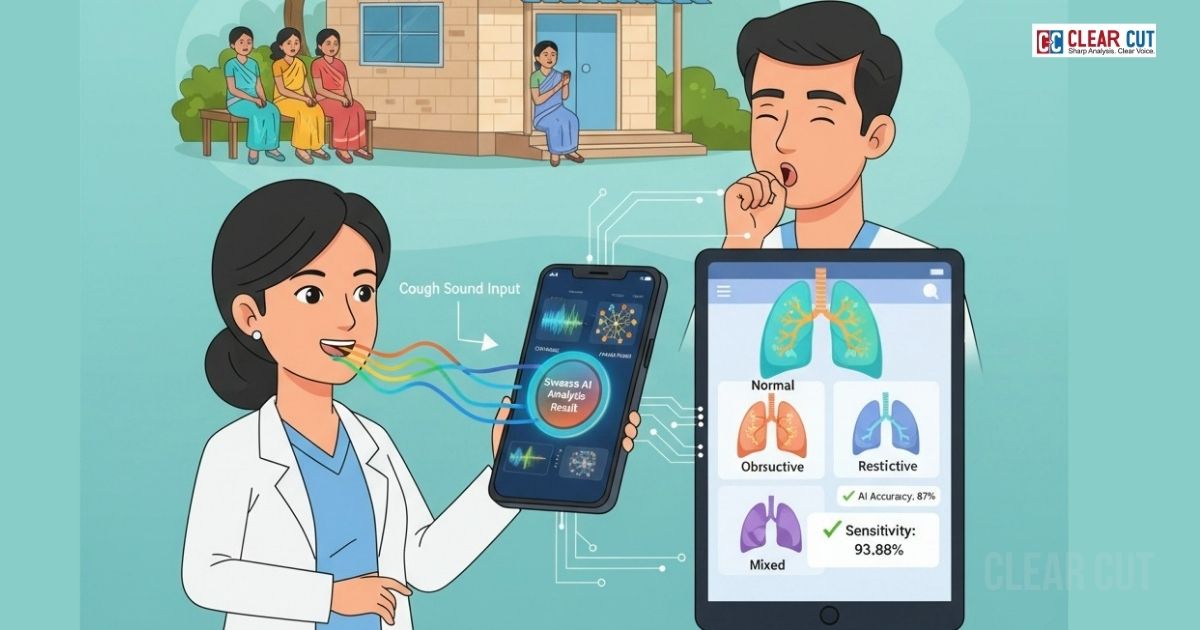
This combination translates to real-world use: in a cross-sectional pilot study with 355 subjects at the Simhachalam Rural Health Centre, India, the Swaasa platform had an extremely high sensitivity of 93.88%, and a specificity of 75.48%, when detecting pathological respiratory disease relative to physician diagnosis, and was 87.32% accurate overall at predicting respiratory risk, indicating significant promise as a preliminary screening tool [Source: Nature article].
Clinical Validation and Respiratory Pattern Classification
Along with determining whether someone is at risk, Swaasa has an advanced pattern classifier which also classifies users into one of four respiratory health classifications: Normal, Obstructive, Restrictive, and Mixed patterns. This will allow for individualized treatment, since each pattern indicates a different underlying lung function abnormality. For example, an Obstructive pattern suggests airway blockage typical of asthma and Chronic Obstructive Pulmonary Disease (COPD), Restrictive patterns indicate limited lung expansion and diseases such as pulmonary fibrosis, while Mixed patterns exhibit features of both.
A comparison of the Swaasa results from the pattern classifier and assessments by the pulmonologist noted strong interrater agreement (Cohen’s kappa = 0.607) that demonstrate the diagnostic accuracy and clinical significance. The ability to classify these patterns via a portable, artificial intelligence platform is meaningful for early intervention in resource limited communities with little to no access to lung function diagnostic capabilities [source: Nature article].
Usability, Safety, and Accessibility in Primary Healthcare
The usability studies for the Swaasa platform included critical task analysis and feedback from the two participants who were healthcare workers and the other two were qualified practitioners in a primary healthcare center. The usability studies revealed that the Swaasa platform users found the interface to be user-friendly, logical and easy to learn, and only suggested minor usability improvements to navigation on screens and session stability. Safety managed was in the proper standardized cough recording, noise mitigating feedback, and between individual uses using hygienic protocols to clean the device.
Swaasa’s non-invasive approach of able to record cough sounds using smartphones gives healthcare providers one way to conduct fast and efficient respiratory screens even in remote or underserved communities without expensive or bulky equipment. Swaasa has the potential to democratize health evaluation, improving preventive care and minimizing the time to diagnosis and leading to an improvement in health status [source: Nature article].
Future Directions: Widening Impact and Improving Accuracy
Ongoing research plans to extend the application of the Swaasa platform to a wide variety of populations and contexts. Looking forward, we plan to conduct studies that will allow for mass screening studies to include multiple languages, cultures, and profiles of respiratory disease to improve generalizability of this model. In addition, diversifying training datasets and improving AI algorithms will also lead to better diagnostic accuracy.
These improvements are essential to achieving AI’s maximum benefits for global respiratory health as scaled solutions of early disease identification, continuous player, and optimized resource allocation within healthcare systems around the world.
Conclusion: Improving Respiratory Health with AI
The emergence of AI-based tools such as the Swaasa platform is a watershed moment for respiratory health, a combination of leading edge technology within accessibility and user-friendly structure. Through the analysis of cough characteristics into actionable clinical insights, Swaasa provides a fast, reliable, and cost-effective pre-screening technology with significant opportunities for global health, particularly in resource-limited countries.
As respiratory diseases continue to stress health systems, innovative solutions like Swaasa offer hope to both health care providers and communities facing respiratory adversity, and provide tools for all to breathe easier.
References:
- “A cross sectional feasibility study to evaluate the usability and efficacy of Swaasa AI platform for rapid respiratory health assessment,” Nature Scientific Reports, 2025.
- Related studies on AI and cough sound analysis for respiratory conditions in journals of respiratory medicine.
- World Health Organization reports on respiratory disease burden and diagnostics.
Clear Cut Health Desk
New Delhi, UPDATED: Nov 12, 2025 02:20 IST
Written By: Antara Mrinal