
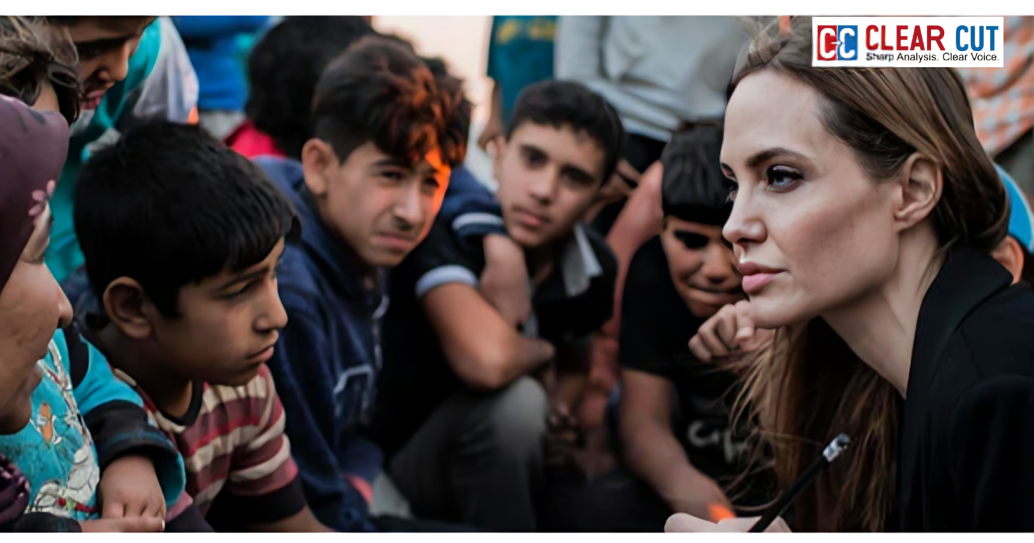
- Angelina Jolie’s visit to Cambodia in 2000 inspired a lifelong commitment to humanitarian work, leading her to serve as a UNHCR Goodwill Ambassador and later Special Envoy while supporting refugees across nearly 50 countries.
- Through legal aid, education initiatives, healthcare projects, and long-term funding for vulnerable communities, she transformed her global influence into meaningful action for refugees and displaced people worldwide.
In 2000, Angelina Jolie was in Cambodia to shoot an action film. She was not there to change her life. But in between for “Lara Croft: Tomb Raider”, she stepped outside the film set and into a country still carrying the scars of war and genocide. What she saw stayed with her. Within months, she had contacted the “United Nations Refugee Agency” and asked a simple question: “How Can I Help?” That question turned into the longest and most consequential relationship between a Hollywood star and a humanitarian cause in recent memory.
After witnessing the realities of displacement in Cambodia, Angelina Jolie transformed celebrity influence into sustained humanitarian action—championing refugees, education, and vulnerable communities through more than two decades of global advocacy.
Goodwill ambassador and a field worker
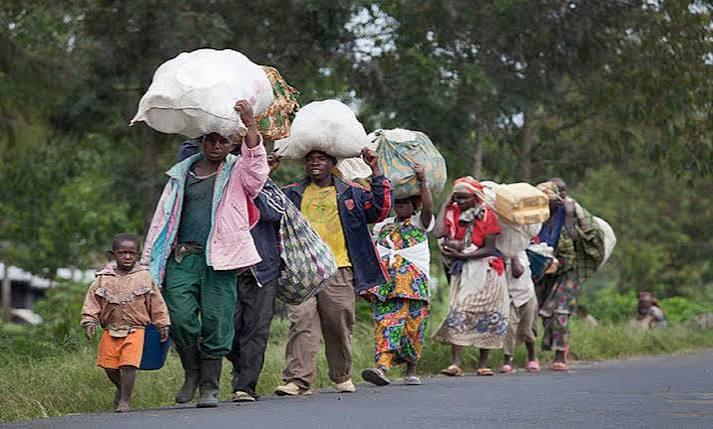
UNHCR, the UN Refugee Agency, named Jolie a Goodwill Ambassador in 2001. It feels like a title a many celebrities would hold for a photo opportunity and a press release. Not for Jolie. Over the next two decades, she simply lent her name to the cause and went to the camps herself. She carried out more than 60 field missions. This allowed her to travel to nearly 50 countries, to sit vis-à-vis with refugee families in places most people only read about in news bulletins (UNHCR, n.d.-a; UNHCR, n.d.-c). In 2012, the agency promoted her to the role of Special Envoy, an expanded mandate that let her engage directly with complex emergencies such as the Syrian civil war (UNHCR, n.d.-a). What set her apart, according to those who worked alongside her was the willingness to actually show up. Be it remote refugee settlements, conflictadjacent border zones, places without comfortable hotels or press handlers. Her most recent missions before stepping down as Special Envoy in December 2022 took her to Yemen and Burkina Faso, two of the most underfunded and least-covered humanitarian emergencies on the planet (UNHCR, n.d.-b). When she announced her departure from the formal UNHCR role, the agency’s High Commissioner Filippo Grandi said simply that her decades of service had “made a difference for refugees and people forced to flee” (UNHCR, n.d.-b).
Money, law and the architecture of help
Visibility was never the whole story. Jolie built actual infrastructure for the causes she cared about. In 2005, she helped launch the National Centre for Refugee and Immigrant Children in Washington, D.C. This was an organisation that provides free legal aid to children who arrive in the US alone, often as victims of trafficking or family separation (Today. com, 2005). By the time of that launch, she had already personally donated more than USD 3 million toward refugee causes (Today.com, 2005). 3 years later, she co-founded Kids in Need of Defence, known as KIND, in partnership with Microsoft. Within 5 years, KIND had become the largest provider of pro-bono lawyers for unaccompanied immigrant children in the country (Wikipedia, 2026).
Education was her other consistent focus. In 2007, at the Clinton Global Initiative’s annual meeting, she co-founded the Education Partnership for Children of Conflict alongside economist Gene Sperling. In its very first year, 19 partner organisations made a combined financial commitment of 148 million dollars to educate 350,000 out-of-school children in conflict zones and improve schooling for nearly 700,000 more (Look to the Stars, n.d.). Unlike her usual outings, this was not a celebrity gala raising awareness. It was policy-grade funding aimed at a measurable outcome: children back in classrooms.
Her own foundation work followed a similar pattern. The Jolie-Pitt Foundation funded TB and HIV treatment centres for children in Cambodia and Ethiopia. It supported rural development and microcredit programmes and contributed a million dollars toward Hurricane Katrina relief in New Orleans (IKMR, n.d.; YesLondonMagazine, 2024). In Cambodia specifically, where her humanitarian journey began, she established the Maddox Jolie-Pitt Foundation named after her eldest son. It has since expanded from wildlife conservation into agriculture, healthcare, and infrastructure projects for local communities (Oscars.org, n.d.).
Her Story Still Matters
It would be easy to read Jolie’s humanitarian record as a long list of donations and trips. The more interesting story is what it reveals about the limits and the possibilities of celebrity influence. Jolie was given a global platform by accident of fame, but she chose to spend that platform on people who have none. They were refugee families with no microphone, no embassy, no headline of their own. In 2020, during the early upheaval of the pandemic, she partnered with the United Kingdom’s government. They collaborated to help secure 5.3 million pounds in new aid to pay the salaries of more than 5,500 teachers working in some of the world’s poorest refugee-hosting countries such as Chad, South Sudan, and Yemen (UK Government, 2020). It was a budget line that kept classrooms open.
When she stepped down as UNHCR Special Envoy in late 2022, Jolie said she wanted “to work differently, engaging directly with refugees and local organisations” (Gulf News, 2026). It was a telling choice of words. After 2 decades inside the architecture of the UN, she seemed to be choosing the harder, less visible work. It was standing beside people rather than speaking for them from a stage.
It is worth pausing on what this kind of commitment actually costs a person with her level of fame. Field missions to active conflict zones are not safe, comfortable or good for a film career’s publicity calendar. Visiting Yemen during one of the world’s worst humanitarian emergencies, or sitting with refugee families in Burkina Faso, does not generate the kind of coverage that benefits her box office (UNHCR, n.d.-b). It generates the kind of coverage that benefits the refugees themselves, briefly, before the news cycle moves on.
Clear Cut Research Desk
New Delhi, UPDATED: July 28, 2026 09:00 IST
Written By: Tanmay J. Urs