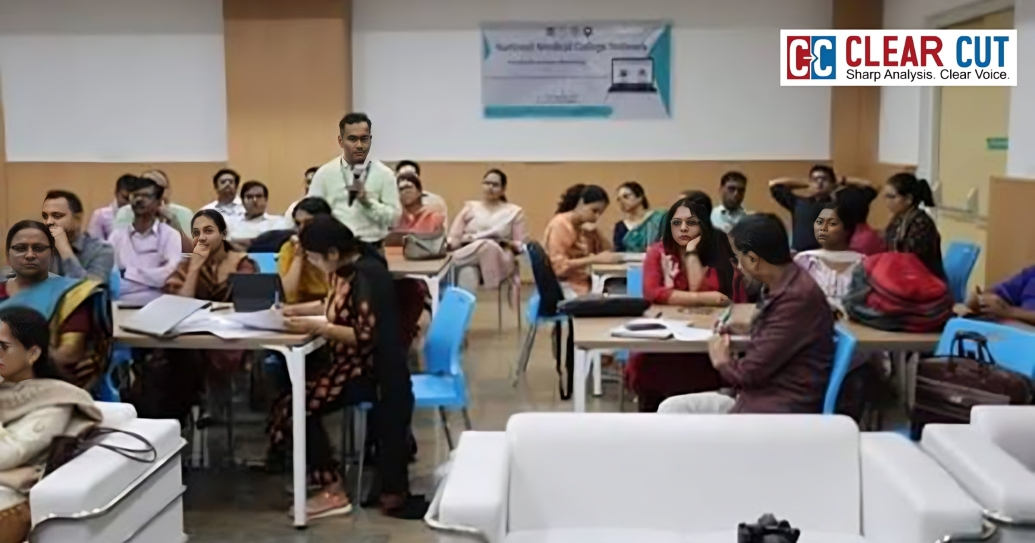
Telangana has launched a major push to modernise medical education. The state government has announced that all 35 government medical colleges will get digital classrooms. The move aims to boost learning quality and ensure uniform standards across urban and rural institutions.
Health and Medical Education Minister Damodar Rajanarasimha announced the initiative at a high-level review meeting in Hyderabad. He said technology must now play a central role in medical training. “There should be no difference in the quality of education provided in Osmania or Asifabad,” he stressed to officials.
The initiative combines modern digital tools with traditional teaching methods. It will begin immediately.
Tools to Transform Teaching
Under the plan, classrooms in all state medical colleges will be equipped with:
- Smart Boards and LED screens for interactive learning.
- Learning Management Systems (LMS) to support course delivery.
- Virtual labs and simulation modules for real-world practice.
- Virtual Reality (VR) tools to help students master anatomy and procedures.
Officials say these tools will help students better grasp complex subjects. The government also plans software that will continuously assess skills and track progress.
Uniform Standards From City to District
Telangana currently admits about 4,140 MBBS students annually. Rapid growth in intake and new colleges has raised concerns about uneven teaching quality. The health minister emphasised digital classrooms will help maintain high academic standards.
Institutions such as Osmania Medical College and Gandhi Medical College in Hyderabad have long reputations. Now, newer medical colleges in districts will also benefit from the technology upgrades.
The government also plans to develop centres of excellence in Osmania, Gandhi and Warangal MGM Medical College. These will focus on emerging technologies like Artificial Intelligence (AI) and Augmented Reality (AR).
Linking National Standards
Minister Rajanarasimha said the curriculum will be aligned with guidelines from the National Medical Commission (NMC) and linked with the National Digital Library to give students access to vast digital resources.
The push mirrors broader educational reforms. Union government data show India’s drive to expand digital education under initiatives like SWAYAM and National Digital Library has strengthened learning ecosystems across disciplines. Independent research notes digital tools help bridge gaps in access and quality in higher education.
What Leaders Are Saying
In support of digital education transitions, Telangana Education Department officials previously told The Times of India that digital infrastructure is central to improving teaching outcomes statewide.
Experts say digital classrooms will also make medical education more resilient. They can help students learn even during disruptions like pandemics, as seen during COVID-19 when digital systems became crucial for continuity of studies.
Impact and Outlook
Students and faculty have welcomed the reform. Many believe it will make practical learning sharper and more engaging. With digital tools in place, Telangana hopes its medical graduates will be better prepared for global healthcare challenges.
The state plans to fully roll out the upgrade this year. Officials say pilot results will guide further enhancements.
Clear Cut Health Desk
New Delhi, UPDATED: Jan 28, 2026 01:00 IST
Written By: Ayushman Meena