
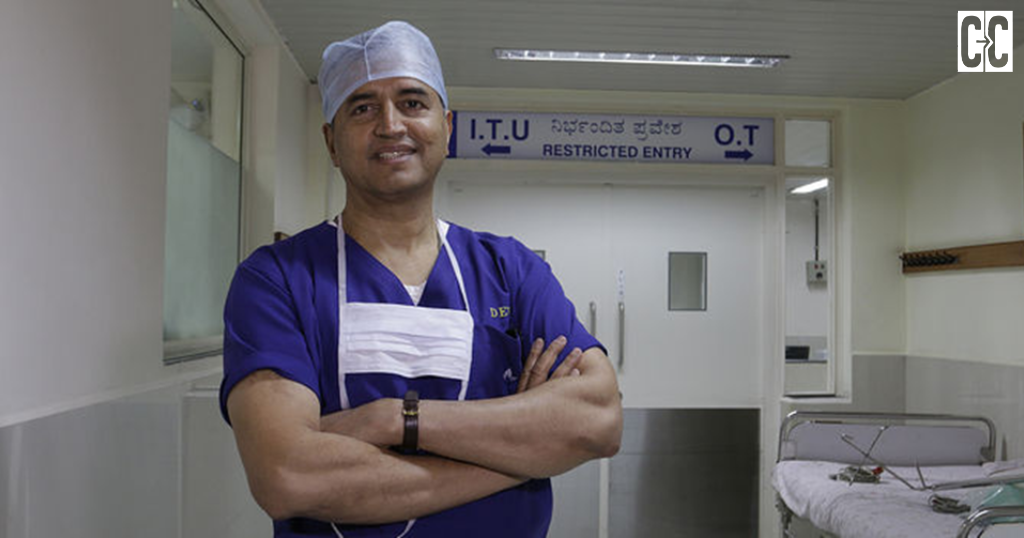
- Dr Devi Shetty has made cardiac care more affordable through Narayana Health by using economies of scale, high-volume surgeries, and a cross-subsidy model.
- His Yeshasvini Micro-Health Insurance Scheme and telemedicine programme have expanded access to healthcare for rural and low-income communities.
The Wall Street Journal called him the Henry Ford of heart surgery. Harvard Business School made his hospital a case study. The World Economic Forum recognised his model as transformational for global healthcare. But the number that matters most in Dr Devi Prasad Shetty’s story is not any of these recognitions. It is ₹95,000. That is what a coronary bypass surgery costs at Narayana Health. The same procedure is billed at approximately $106,385, or close to ₹89 lakh, at the Cleveland Clinic in Ohio. Shetty has not simply made cardiac surgery cheaper. He has demonstrated, through 25 years of operational data, that the trade-off between quality and affordability that high-cost healthcare systems have treated as inevitable is, in fact, a choice.

Economies of scale as a healthcare philosophy
Shetty’s insight was straightforward in principle. The unit cost of a surgery drops if you perform a very large number of them. High volume enables bulk procurement of medical supplies, specialised surgical teams that develop exceptional skill through repetition, efficient use of operating theatres, and streamlined processes that reduce waste at every step. Narayana Health today handles approximately 12 percent of all heart surgeries performed in India. Forty percent of those procedures are on children. The network spans 47 facilities, including hospitals in 18 cities across India and one in the Cayman Islands.
₹10 a month and 4 million farmers covered
In 2003, Shetty partnered with the Karnataka government to design the Yeshasvini Micro-Health Insurance Scheme. This programme allowed rural farmers to access major surgical care for a contribution of as little as ₹10 per month. The scheme covered 805 surgical procedures, including 131,000 heart operations, and by 2024 had facilitated 1.2 million surgeries for people who could not otherwise have afforded them. Over four million people enrolled. The scheme has since been merged with the central government’s Ayushman Bharat health insurance plan, effectively being absorbed into national policy.
Children, Mother Teresa, and the moral origin of the mission
Shetty was Mother Teresa’s personal physician for the last five years of her life, attending to her after her 1996 heart attack. He has described her influence on him in direct terms: she showed him that medicine is about humanity, not just skill. His particular focus on paediatric cardiac care reflects a recognition that congenital heart disease in India is overwhelmingly a disease of poverty: children who need surgery die waiting because their families cannot access or afford treatment in time. Free and subsidised care for poor children accounts for a substantial share of Narayana Health’s total surgical load, a cross-subsidy model in which paying patients fund access for those who cannot pay.
Telemedicine and the 53,000 patients reached at no cost.
Narayana Health’s telemedicine programme has served over 53,000 patients free of charge, extending specialist cardiac consultations to remote areas where travelling to Bengaluru would cost a patient more than the consultation itself. The programme is part of Shetty’s stated goal to cut the cost of heart surgery further over the coming decade, using telemedicine, surgical robotics, and further economies of scale to keep pushing the floor down. The ambition is not primarily commercial. It is the same ambition he had when he was 14 years old in Mangalore, reading about the world’s first heart transplant and deciding that was what medicine should be for.
Conclusion
Dr Devi Shetty has done in one hospital network what Indian public health policy has been unable to do at scale: make world-class cardiac care available to farmers, labourers, and families earning informal incomes. His Yeshasvini model’s integration into Ayushman Bharat is the strongest validation of this. The next step belongs to the Union Health Ministry: study the full operational data from Narayana Health’s 25 years of cross-subsidised, high-volume cardiac care and build a national protocol for publicly funded surgical care that uses these same economies of scale. India performs 80,000 to 90,000 heart surgeries a year. It needs 2.5 million. That gap is not a medical problem. It is a policy and financing problem, and one doctor has already shown how to address the cost side.
Clear Cut Health Desk
New Delhi, UPDATED: September 17, 2026 11:38 IST
Written By: Tanmay J. Urs