
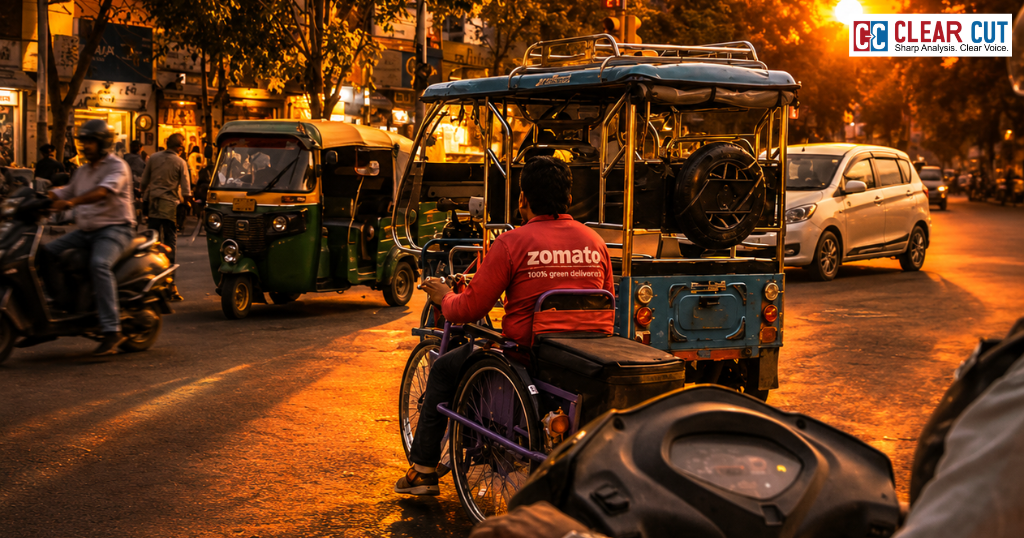
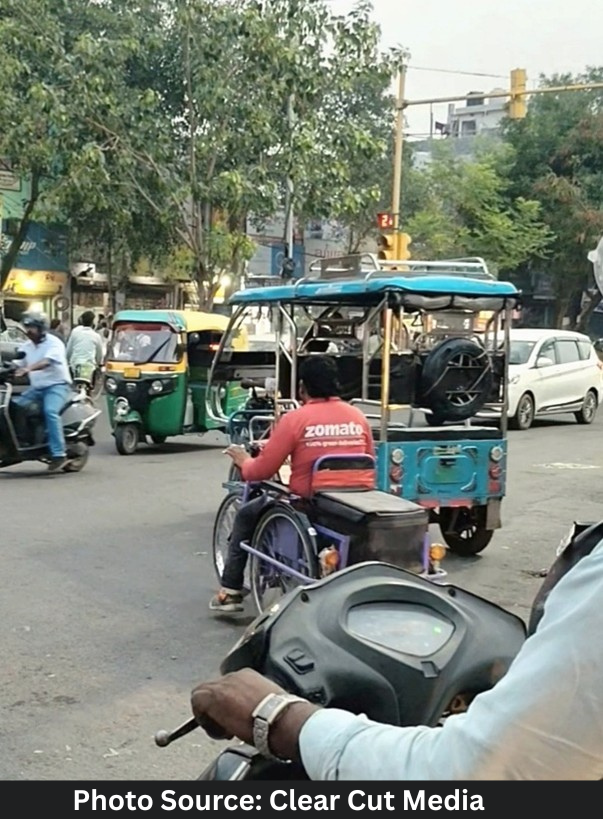
At a busy traffic signal, surrounded by speeding scooters, autos, and impatient commuters, a man in a wheelchair moves steadily ahead. He wears a Zomato jacket, carrying not just deliveries but a lesson for an entire city.
Every day, we scroll through our phones and order food with a few taps. Within minutes, a delivery rider appears at our doorstep. Most of us never stop to think about the journey behind that delivery – heat, traffic, long hours, and relentless pressure to meet deadlines.
The other day, I noticed a Zomato delivery guy navigating through a busy intersection on my way home. His determination set him apart from the crowd, not his disability. This man proved the fact that mobility issues do not reduce anyone’s passion or ability by proceeding ahead while others zoomed right past him.
His story remains unknown. Perhaps he is delivering orders. Or perhaps he is returning home after work. Either way, there is a fundamental question that comes to mind here: how many barriers does he overcome every single day that we fail to realise?
The problem is not only about the physical struggle for many people suffering from impairments. It is also a matter of the continual struggle to feel valued, the lack of easily available infrastructure, and poor chances for employment. Every office that offers job opportunities to individuals with some kind of disability helps in the process of inclusion. Every person willing to work instead of being dependent on others breaks numerous stereotypes.
India hosts 2.68 crore people with various disabilities that amount to 2.21% of the total population of this country. 69% of them live in rural areas whereas 31% live in the cities. Nevertheless, the real number of people with disabilities could be greater. According to the World Bank report, there is increasing evidence suggesting that between 5% and 8% of all Indians or 55 to 90 million people are disabled.
Resilience does not always come out as strong in some cases as illustrated by this particular guy. It sometimes crawls through potholes, bottlenecks, and roads without any accessibility facilities. Sometimes resilience makes him spend many working hours earning money in a delivery uniform. Occasionally, it delivers us our dinner along with another essential lesson-life lessons of endurance and perseverance.
The Project ZEAL
In December 2022, Zomato launched Project ZEAL (Zomato’s Equitable Action for Livelihood), which aimed to see whether delivery work through a gig economy provided any earning opportunities for individuals with disabilities. Over 400 disabled people suffering from locomotor disability, mostly wheelchair users, were employed as delivery partners in 50 cities, such as Delhi, Bangalore, Mumbai, and Hyderabad, before March 2024, and had carried out over 6 lakh orders of food deliveries within 15 lakh kilometres.
The delivery man was not an exceptional case since there are many other men and women like him; these include over 400 wheelchair users, who have made food deliveries in India for up to 15 lakh kilometres.
There are 12 million gig workers in India, but their number is expected to grow to 24 million in the following decade. However, gig workers have never been afforded any protection from the government. Gig workers spending 90 days of a year working on any platform will enjoy benefits under the newly formulated labour law, effective in 2026.
Despite India’s ratification of the UN Convention on the Rights of Persons with Disabilities, which explicitly prohibits discrimination against individuals with disabilities in matters of employment and provides for reasonable accommodation, individuals with disabilities continue to suffer in many ways. In addition to limitations in their social lives due to social stigmatisation, they also have to endure difficulties in accessing jobs, education, and rehabilitation.
Maybe the real inspiration lies in those few individuals who keep going despite all the obstacles thrown their way in an era of convenience and speed. Their courage makes us question everything we thought about talent and success and human capability.
One idea persisted as cars raced ahead and the traffic light turned green: Some deliver food. Some deliver hope.
Clear Cut Livelihood Desk
New Delhi, UPDATED: June 10, 2026 09:00 IST
Written By: Muskan Pal