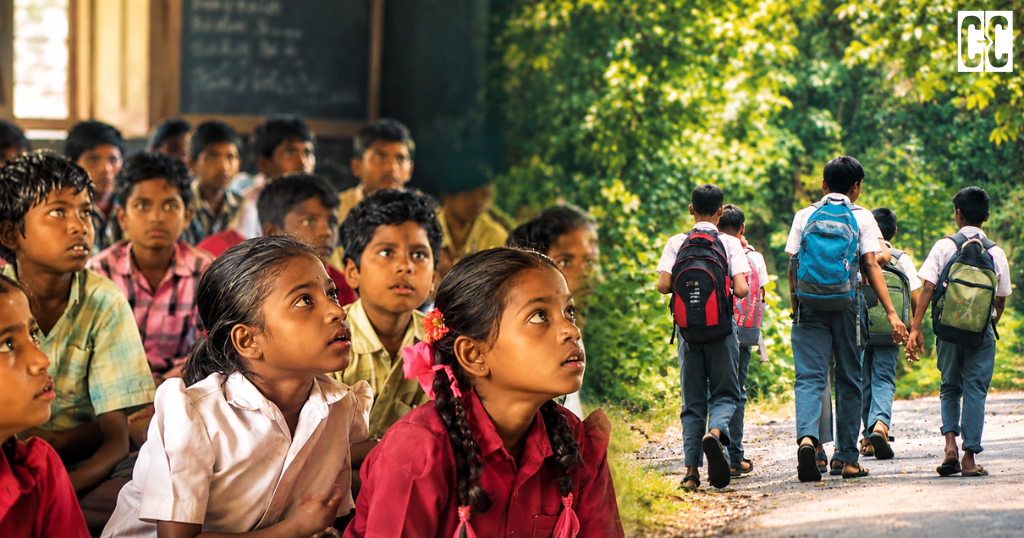

- India has 10.27 million school teachers, yet major teacher shortages remain.
- Over 100,000 schools have only one teacher, affecting nearly 2.91 million children.
- Teachers face heavy workloads, administrative duties and non-teaching responsibilities.
- Private-school teachers often face significantly lower pay and weaker job security.
- Better teacher deployment, working conditions, pay and professional status are essential to improving learning.
On World Teachers’ Day, Clear Cut looks beyond the celebrations at teacher vacancies, working hours, non-teaching duties and pay—and asks how India compares with the US and China.
Every year on October 5, World Teachers’ Day brings familiar messages of gratitude. Schools celebrate teachers. Students thank them. Governments speak about their role in building the nation.
But behind these celebrations lies a more basic question: are we giving teachers the conditions they need to teach well?
India now has more school teachers than ever before. UDISE+ 2025–26 puts the number at 10.27 million, up from 10.12 million the previous year.
That sounds encouraging. But national numbers hide a more complicated reality. That includes how they are employed, how much time they spend in the classroom, and how differently the system treats government- and private-school teachers.
10 million teachers, but teacher shortages remain
India’s teacher numbers have grown substantially. The national pupil-teacher ratio is also within prescribed norms in aggregate.
Yet distribution remains a problem.
UDISE+ 2025–26 records 100,843 single-teacher schools, educating about 2.91 million children. In other words, nearly 29 lakh children attend a school where one teacher may have to handle multiple classes, administrative responsibilities and the running of the school itself.
Like any average, the national pupil-teacher ratio may be misleading and needs careful interpretation. A good national average does not mean every school has enough teachers.
Vacancies add another layer. Parliamentary data for 2024–25 showed around 9.83 lakh vacant school-teacher posts, including more than 5.7 lakh at the elementary level.
The developed nations are no different. A similar pattern is seen in the United States, where it also struggles with teacher shortages.
In 2024, the US National Center for Education Statistics found that 74% of public schools reported difficulty filling at least one teaching vacancy. Shortages were particularly visible in special education and science.
So teacher shortages are not uniquely Indian. But India’s scale, regional differences and large number of single-teacher schools make the challenge different.
How many hours do teachers in India really work?
India’s Right to Education framework specifies 45 working hours a week for teachers, including time spent preparing lessons.
But working hours and teaching hours are not the same thing.
A teacher does not stop working when a class ends. Lesson planning, checking notebooks, assessments, meetings, reporting, parent interactions and administrative responsibilities all consume time.
In the OECD’s TALIS 2024 survey teachers in the United States, reported 28.1 hours in the United States of actual teaching per week in OECD’s TALIS 202 highest teaching loads across participating education systems.
Shanghai presents another interesting picture. Full-time lower-secondary teachers there reported working 46.9 hours a week.
So China is hardly a low-workload system.
Yet TALIS also found that about 70% of Shanghai teachers felt teachers were valued in society. Only 26% of American teachers said the same.
This suggests that hours alone do not determine whether teaching is an attractive profession. Pay, professional autonomy, social status and working conditions matter too.
When teaching is only one part of the job
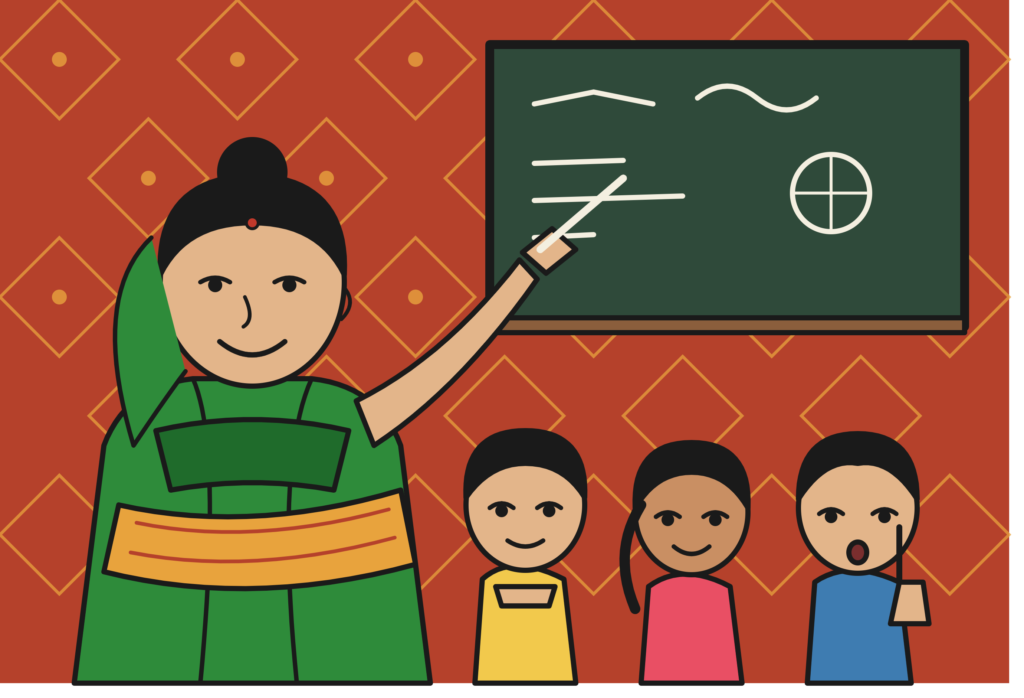
For India’s government-school teachers, another issue repeatedly surfaces: non-teaching duties.
The Right to Education Act actually restricts their deployment for non-educational purposes. But it makes specific exceptions for the population census, disaster relief and elections.
The Ministry of Education has also said electoral-roll revision involving teachers should take place during holidays, non-teaching hours and non-teaching days.
That raises an uncomfortable question.
If classroom time is protected by shifting election work outside school hours, whose time is actually being protected?
The teacher may teach during the day and complete electoral responsibilities afterwards.
Recent experiences around electoral-roll revision and Special Intensive Revision, or SIR, have again brought this issue into focus.
Then there are surveys, data collection, reporting requirements, government campaigns and other administrative demands that teachers may encounter.
And sometimes the burden is less visible.
Priya Kushwaha (name changed), a government-school teacher from Uttar Pradesh, described another responsibility that rarely figures in discussions about teachers’ workloads. She is expected to go around the village encouraging families to send their children to school.
For Kushwaha, the frustration is not simply about the additional work. She believes it is also changing the relationship between teachers, students and parents.
“When we have to repeatedly go to families and persuade them to send their children to school, some parents and students begin to feel that the school needs them more than they need the school,” she said.
In her experience, this has gradually diminished some of the respect and authority that teachers once commanded within the community.
It is one teacher’s experience, not a national finding. But it points towards an issue worth examining: what happens to the teacher’s professional identity when teaching becomes only one of many responsibilities?
Private school teachers face a different reality
If government teachers struggle with additional responsibilities, many private-school teachers face another problem altogether: employment conditions.
Pratibha Bhasin (name changed), a teacher at a leading private school in Delhi, described a very different kind of working condition.
“There are no chairs for teachers in our classrooms because we are supposed to stand and teach,” she said. “That can mean being on your feet for almost eight hours.”
Her experience cannot be generalised to India’s vast and diverse private-school system. But it offers a glimpse into working conditions that rarely feature in public conversations about teacher welfare.
National research suggests that this larger question deserves much greater attention.
The Tata Institute of Social Sciences’ State of Teachers, Teaching and Teacher Education Report 2023 analyzed PLFS data and conducted primary research covering 3,615 teachers in 422 schools across eight states.
Its findings reveal a remarkable divide.
Private primary and secondary teachers earned, on average, only about 35% of the salaries earned by government teachers. Even private teachers with longer contracts earned only around 45–50% as much as government teachers.
Job security was another concern. More than half of non-government teachers in the PLFS analysis had no written employment contract.
Yet private teachers do not necessarily teach fewer classes.
The TISS study found broadly similar weekly teaching loads: around 28 teaching periods in private schools compared with 27 in government schools.
India, therefore, appears to have created two very different problems within the same profession.
Government teachers generally have better salaries and greater employment security but may carry significant administrative and public responsibilities.
Private teachers can face similar classroom demands while receiving far lower salaries and weaker employment protection.
What China gets right about teacher status
China offers an interesting comparison, not because its education system should simply be copied, but because of how its law defines the status of teachers.
China’s Compulsory Education Law states that the average salary of teachers should not be lower than that of local civil servants. It also provides for welfare and social insurance and additional support for teachers working in remote or disadvantaged areas.
The outcome is worth noting.
In TALIS 2024, 59% of Shanghai teachers said they were satisfied with their salaries, compared with an OECD average of 39%.
In the United States, the figure was also 39%.
Perhaps even more strikingly, 92% of Shanghai teachers reported overall job satisfaction.
Their working hours remain long. But the profession appears to enjoy comparatively high social recognition: about 70% said teachers were valued in society.
The question is bigger than salary
Teacher policy therefore cannot be reduced to recruitment.
India certainly needs to fill vacancies and ensure that every school has an adequate mix of teachers. But adding teachers without examining how their time is used solves only part of the problem.
Four questions deserve attention:
- Deployment: Are teachers located where children actually need them?
- Time: How much of a teacher’s working week is genuinely available for teaching, preparation and students?
- Conditions: Do schools provide teachers with basic professional dignity, reasonable workloads and secure employment?
- Pay: Can India justify a system in which people performing broadly similar classroom roles can have dramatically different salaries and employment protection simply because one works in a government school and another in a private one?
These are not questions about making life comfortable for teachers.
They are questions about learning.
A teacher who is filling government forms, conducting electoral work, chasing enrolment, working without employment security, worrying about inadequate pay, or simply standing for eight hours because the school does not believe teachers should sit is carrying something into the classroom besides a lesson plan.
Sixty years ago, the landmark 1966 ILO-UNESCO Recommendation concerning the Status of Teachers described teaching as a profession requiring specialised knowledge and skills.
On World Teachers’ Day 2026, perhaps that is the principle worth returning to.
India has succeeded in putting more than 10 million teachers into its education system.
The next question is harder.
Are we allowing them to be teachers?
Clear Cut Education Desk
New Delhi, UPDATED: October 04, 2026 11:00 IST
Written By: Paresh Kumar
[The author serves as the Managing Editor of Clear Cut & CEO of Dev Insights]