
- India’s Labour Codes have overhauled the country’s employment laws, formally recognising gig and platform workers while introducing provisions for social security, wages, industrial relations, and workplace safety reforms.
- States like Karnataka, Rajasthan, Bihar, and Jharkhand have taken additional steps with dedicated gig worker welfare laws, but delays in implementation and non-operational welfare boards continue to limit real benefits.
- As India’s gig workforce grows rapidly, the new legal framework offers long-term protection, but effective enforcement and timely execution remain the biggest challenges.
On January 1, 2026, delivery workers across Delhi-NCR, Mumbai, and Bengaluru walked off the job. The strike was nationwide. It was also historic. For the first time, India’s gig workforce collectively demanded dignity, regulation, and accountability from the platforms that run their lives.
On 21 November 2025, the Government of India brought the four Labour Codes into force, and official labour ministry materials describe them as consolidating 29 central labour laws into a single framework. The four codes are the Code on Wages, the Code on Social Security, the Industrial Relations Code, and the Occupational Safety, Health and Working Conditions Code. The Code on Social Security includes provisions for gig workers and platform workers, while the Industrial Relations Code raises the threshold for prior government approval for layoffs, retrenchment and closure from 100 to 300 workers.
What the Labour Codes Actually Do
The four codes cover wages, social security, industrial relations, and occupational safety. Together they overhaul India’s employment law framework in ways not seen since independence.
The Code on Wages standardises minimum wage calculations. It introduces a uniform definition where wages must form at least 50% of total remuneration, directly impacting how companies structure CTC packages. The Industrial Relations Code raises the threshold for layoffs requiring government permission from 100 to 300 workers, offering employers more flexibility while also introducing fixed-term employment with full statutory parity.
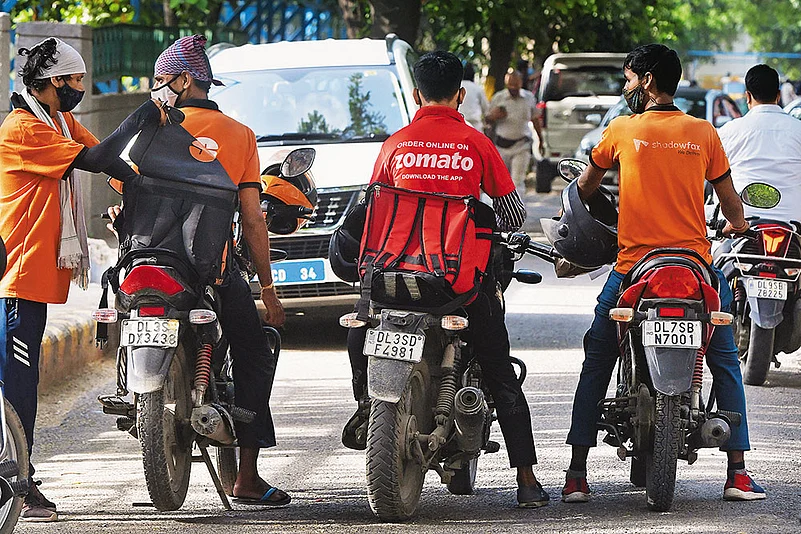
The most consequential change for gig workers comes from the Code on Social Security. It formally recognises gig workers, platform workers, and aggregators in Indian law for the first time. Platforms like Zomato, Swiggy, Blinkit, and Ola are now legally required to contribute 1 to 2% of their annual turnover into a dedicated social security fund covering health insurance, disability benefits, and old-age protection.
Karnataka Steps Up
Karnataka became the second state after Rajasthan to pass a dedicated gig worker welfare law, doing so in May 2025. The Karnataka Platform Based Gig Workers (Social Security and Welfare) Act is considered more comprehensive than Rajasthan’s 2023 law.
It establishes a tripartite welfare board with direct worker representation. Platforms must pay a welfare fee of 1 to 5% per transaction. Workers receive mandatory written notice before account deactivation. Algorithmic transparency requirements are built in. A two-tier grievance mechanism with set time limits gives workers a formal channel to raise complaints.
According to Countercurrents, Karnataka’s law potentially covers around 4 lakh gig workers. Bihar and Jharkhand followed with their own laws in August 2025. Jharkhand notably ties platform contributions to gross revenue rather than per-worker payouts, a model analysts say could generate significantly more for welfare funds.
The Ground Reality
Despite legislative progress, the gap between policy and pavement remains wide.The Economic Survey 2026 warned of the gig economy’s “unstable foundations,” noting that platforms charge 25 to 35% commissions while workers take home median monthly earnings of ₹14,000 to ₹18,000 after fuel, repairs, and equipment costs. Urban living wages in Delhi and Bengaluru are estimated at ₹22,000 and ₹19,000 respectively. Reaching advertised incentive thresholds requires 14 to 16-hour workdays.
Writing in The Week in May 2026, Rishi Agrawal noted that “labour became a variable cost rather than a fixed liability for platforms” and that the new codes represent “a shift in India’s economic history” but acknowledged the specifics remain unresolved with “contributions and boards that do not exist.”
Zomato co-founder and CEO Deepinder Goyal, responding on X to worker safety concerns, said all delivery partners are provided medical and life insurance. He maintained the 10-minute delivery model is enabled by store density, not worker speed. He added that gig work “is not designed to be a long-term role,” citing a 64% attrition rate. Workers and unions rejected this framing.
The Oxford Human Rights Hub noted a significant exclusion: gig workers are kept out of the Occupational Safety, Health and Working Conditions Code, meaning protections around working hours, health checks, and preventive safety standards do not apply to them.
Draft central rules released in January 2026 propose that workers must be engaged with a single aggregator for at least 90 days to qualify for benefits. For those working across multiple platforms, the threshold rises to 120 days. Critics argue this design excludes the most precarious workers, those who piece together income across several apps.
A Law on the Books Is Not a Life Changed
As of December 2025, over 31.2 crore workers are registered on the e-Shram portal. The infrastructure exists. The legal vocabulary now includes gig workers. But contribution rates under the Social Security Code are still pending full notification. Welfare boards in most states are not yet operational.
India’s gig workforce is projected to reach 23.5 million by 2030. The Labour Codes give these workers a seat at the table for the first time. Getting them a fair share of what they earn will require more than a law on the books.
Clear Cut Research Desk
New Delhi, UPDATED: June 29, 2026 01:00 IST
Written By: Tanmay J. Urs