- India is rapidly expanding its semiconductor and AI ecosystem through Semicon 2.0 and the IndiaAI Mission, with new fabs, GPUs and indigenous AI models.
- Despite this growth, talent shortages, the gender gap in STEM jobs and lower investment than global competitors remain major challenges.
- The real test is whether India can turn its chip and AI boom into inclusive opportunities and benefits for everyone.
In a cleanroom in Sanand, Gujarat, technicians in bunny suits now handle silicon wafers that India could not package on its own eighteen months ago. The plant belongs to Kaynes Semicon, which shipped the country’s first commercially produced multi-chip modules in late 2025 — a milestone shared with neighbouring Micron and CG Semi, and marked by a visit from Prime Minister Narendra Modi. It is a small, concrete image of a larger claim in a recent PIB backgrounder marking India’s 80th Independence Day: that India is no longer just designing chips on paper, but making them — and building the AI systems those chips will run.
Approved in six states Since December 2021, India’s semiconductor mission has approved 12 projects in six states, bringing in over 1.64 lakh crore of committed investment. While the first phase (Semicon 1.0) was on a ₹76,000 crore outlay, Semicon 2.0, in July by the Union cabinet to be operational by July 2026, stands on a virtually doubled outlay of ₹1,27,500 crore over six pillars (see table) – from design to talent– A genuine inflection point. Three fabs are currently shipping product. Not merely breaking ground.
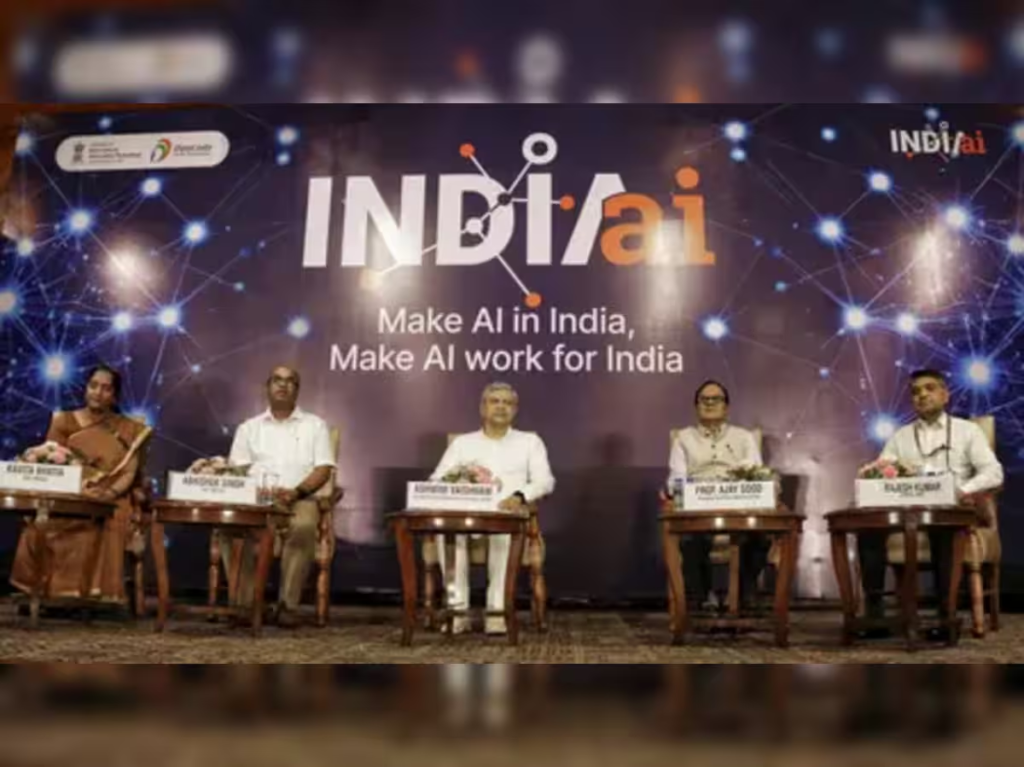
For the Semiconductor push, there is a sister mission. It is the India AI Mission that has increased the availability of shared computers to more than 45,000 GPUs, approved 93L+ GPU hours for 237 projects, and is building 20 foundation models in indigenous languages. This contributes to Stanford’s 2025 Global AI Vibrancy and lists India third globally, after only the US and China.
What is more captivating is who stands to receive these benefits? The rise of smaller language models addresses some aspects of this by training models on all 22 scheduled languages and even some tribal dialects – farmers, eventually, may be asking an agricultural question in Tamil rather than English. One aspect of India’s diversity that needs tailored training rather than imported systems is technology education. Prof Arnab Bhattacharyya (IIT Kanpur) would even say that technology education needs a ‘culturally soaked system,’ says Prof Sudeshna Sarkar (IIT Kharagpur).
Inclusion faces harder limits elsewhere. Women may hold 43 percent of India’s STEM qualifications – higher than in the U.S., Britain, and Germany – but they hold fewer than 27 percent of STEM jobs, which some call a “leaky pipeline”. S Krishnan, the secretary for the Ministry of Electronics and IT, described a more extreme version: China and India design a combined fifth of the world’s semiconductors, but both lack sufficient senior talent to manage the new manufacturing plants opening in their respective territories.
Ashwini Vaishnaw, the IT minister, says the sector’s immediate needs are more than a million workers. The twelve approved projects, which will primarily take place across six states, will go a long way toward showing whether Mr. Modi can really meet such a broad objective.
India isn’t the only nation in the race, and the gap in scale matters too. The US is up around $53 billion in direct Chips Act spending. TSMC is putting $265 billion into its Arizona expansion.
China is using some $47.5 billion in state-backed support to spur Huawei’s HiSilicon and the foundry SMIC to a 7-nanometer milestone despite existing export bans. Europe’s 43 billion-euro Chips Act to boost local market share back up to 20% by 2030. And while India’s Semicon 1.0 and 2.0 initiatives together represent some $21 billion in real progress that’s starting to pick up steam, it’s a fraction of what its rivals are spending. It’s the same with artificial intelligence: The UNCTAD’s 2025 Technology and Innovation Report says the US accounted for 70% of worldwide private AI investments in 2022. Even worse, the vast majority of nations in the Global South 118 countries total aren’t even at the AI governance table.
The goal must be “technology to people” or the global south gets left in the dust, UNCTAD Secretary-General Rebeca Grynspan explains.
The country may have allocated $1.25 billion to AI projects (according to Stanford University tracking). Still, Saudi Arabia’s Project Transcendence pledges $100 billion-just one of many examples of how AI “vibrancy” stats and direct dollar commitments don’t go together.
TABLE — India’s missions, at a glance
| Semicon 1.0 (2021) | Semicon 2.0 (2026) | IndiaAI Mission | |
| Outlay | ₹76,000 crore | ₹1,27,500 crore | ₹10,372 crore |
| Scale approved | 12 projects, 6 states | 6 pillars; 12-yr runway | 20 foundation models (12 LLM + 8 SLM) |
| Status (Aug 2026) | 3 facilities in commercial production | Newly approved; six pillars mobilising | 45,000+ GPUs; 93.18 lakh GPU-hrs used |
| Talent & access | 320 institutes, 68,000+ students (C2S) | Talent named a core pillar | 58 AI CoEs approved; 22 actives in 13 states/UTs |
Figures as officially reported by the Ministry of Electronics & Information Technology / PIB, current as of August 2026.
FIG. 1 — Where India’s semiconductor bet stands globally
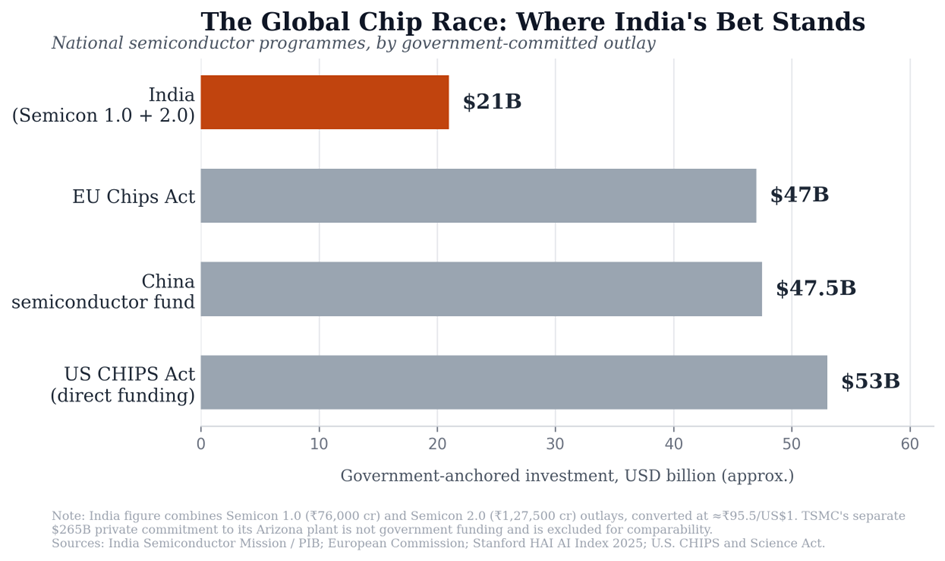
Note: India figure combines Semicon 1.0 and Semicon 2.0 outlays, converted at ≈₹95.5/US$1. TSMC’s separate $265B private Arizona commitment is excluded for comparability. See sources below.
At the February India AI Impact Summit in New Delhi, India, the same old slogan was offered to make the case: Sarvajan Hitaya, Sarvajan Sukhaya, for all-around welfare, all-around happiness – an argument that persuaded 92 countries in the inclusive AI declaration. The real test to measure that proposition isn’t by counting the latest GPUs and planned mega-fabs, but whether you can become a fab technician equally through state-run ITI, state-run IIT, and whether as many female engineers as male create your next small language model. Three fabs for us now, state six, the skill deficiency is for real. Viksit Bharat’s silicon story is still under writing, not for everyone.
Clear Cut Health, Research Desk
New Delhi, UPDATED: August 20, 2026 16:02 IST
Written By: Yatharth Pathak