
- ₹9,450 crore approved for 410 km of new railway tracks.
- Project will connect 6,448 villages and 60 lakh people.
- Odisha is expected to gain significantly from improved connectivity.
- Rail expansion could boost freight capacity, jobs and local livelihoods.
- Projects aim to cut logistics costs and around 65 crore kg of CO₂ annually.
New Delhi: The Union Cabinet, headed by Prime Minister Narendra Modi, on Wednesday approved four railway multi-tracking projects with an investment of around Rs 9,450 crore to add nearly 410km of new tracks in eight districts spread across West Bengal, Odisha, Tamil Nadu, and Andhra Pradesh, and aimed to be completed by 2030-31.
The four identified corridors – Kharagpur-Bhadrak (Ranital), Bhadrak-Haridaspur, Gummidipundi-Gudur, and Cuttack-Paradeep (Badabandha) – will introduce an additional line in sections of the Howrah-Chennai high-density corridor, one of the busiest passengers and freight trunk routes for the Indian Railways.
As many as three of the four identified lines in whole or in part pass through Odisha, the hub of the expansion. The state will benefit from improved railway connectivity in many of its remote regions, with about 6,448 villages and 60 lakh people. Still, the new lines are expected to generate about 49 lakh human-days of construction work and 173 crores in annual logistics cost savings once they are ready, according to data on the lines presented in their project documents.
Noting that the project would provide a fresh boost to the region’s tourism, pilgrimage, and local livelihoods, Mohan Charan Majhi, Chief Minister of Odisha, wrote in a letter of thanks to the Centre for the project, in reference to sites like Bhitarkanika National Park and Chandipur Beach, and the Buddhist pilgrimage site, Lalitgiri, on new corridors. This is the second Odisha-centred rail package this year to be cleared by the CCEA in barely 5 weeks, after a Rs 3,907 crore package for Odisha and Jharkhand on July 15, underscoring how the state has assumed an indispensable role in the Centre’s quest for a western rail push this year. Overall, findings from independent research align with the access argument.
An analytical survey of research on Indian Railways published in December 2025 in the International Journal of Creative Research Thoughts suggested that, at the district-level, increased rail access was directly proportional and positively correlated with industrialisation, urbanisation and labour mobility. These trends were, in the authors’ words, “contributing to narrowing down disparities in regions.” There, however, warns that all benefits will be contingent on the existence of the final mile- feeder roads and bus services to new stations.
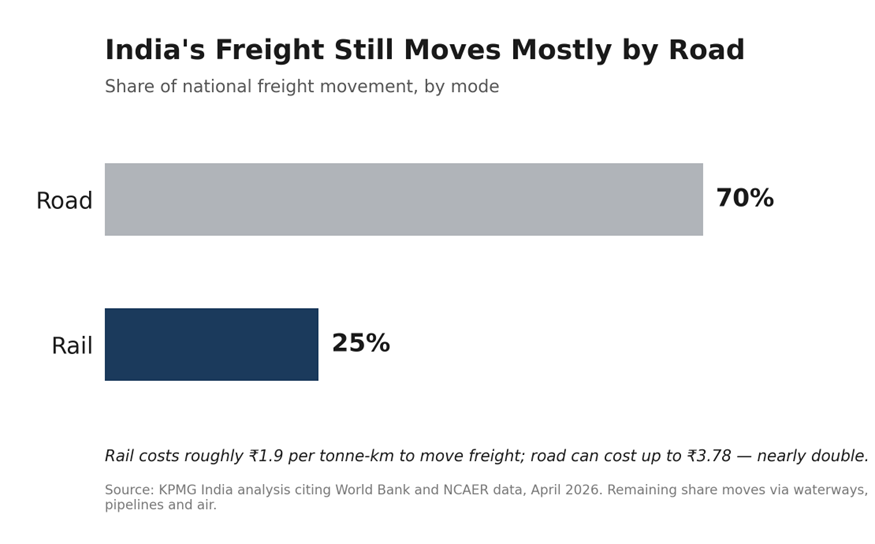
The freight case, indeed, suggests a larger imbalance. China moves about 70 percent of its freight by rail and only about one quarter by road (KPMG India, “Competitive Advantage: Reimagining India’s logistics”, April 2026, quoting World Bank and NCAER data). By road, India moves two-thirds to three-quarters of its freight. Rail is less than one-fourth of both (and that too about the same as China, nearly half as expensive per tonne-km, according to that report), India’s overall logistics cost accounted for nearly 8 percent of GDP, according to another study by NCAER last September.
CCEA’s own calculation follows this logic: The projects’ extra-freight capacity of 76 MT/year is estimated to reduce oil imports by nearly 13 crore litres and avoid about 65 crore kg of CO2 emissions annually, which “as many as 2.6 crore additional trees will achieve on an annual basis,” the government says.
Because multi-tracking projects typically add lines along existing railway right-of-way rather than carving fresh alignments, they tend to require less land acquisition and displacement than greenfield lines though the final land footprint for each stretch will only be clear once detailed project reports are finalised and on ground surveys begin.
AT A GLANCE
| ₹9,450 crore Total project cost | 410 km New track added |
| 2030-31 Completion target | 6,448 Villages connected |
| ~60 lakh Population reached | 76 MTPA Added freight capacity |
| 49 lakh Human-days of employment | ~65 crore kg CO₂ cut per year |
THE NATIONAL PICTURE
THE FOUR APPROVED PROJECTS
| Project | Length | States Covered |
| Kharagpur–Bhadrak (Ranital), 4th Line | 173 km | West Bengal, Odisha |
| Bhadrak–Haridaspur, 4th Line | 75 km | Odisha |
| Gummidipundi–Gudur, 3rd & 4th Line | 90 km | Andhra Pradesh, Tamil Nadu |
| Cuttack–Paradeep (Badabandha), 3rd & 4th Line | 72 km | Odisha |
| Total | 410 km | 8 districts, 4 states |
Clear Cut Livelihood Desk
New Delhi, UPDATED: August 21, 2026 16:30 IST
Written By: Yatharth Pathak