- Despite higher budget allocations, Samagra Shiksha Abhiyan is facing funding and utilisation challenges, with approved state budgets declining and only a portion of allocated funds being spent.
- Experts warn that reduced funding share, delayed fund releases, and Centre-state disputes over NEP 2020 and PM SHRI implementation are affecting government schools, infrastructure, and student support programmes.
- The funding gaps could hinder India’s goal of achieving universal school enrolment by 2030, particularly impacting millions of students in ordinary government schools.
India’s largest school education scheme is facing a quiet funding crisis. Samagra Shiksha Abhiyan, the Union government’s flagship programme covering school education from pre-primary to Class 12, is receiving higher headline allocations on paper. But the real story lies beneath the numbers.
Even as Budget 2026-27 increased allocations for Samagra Shiksha, budget cuts have resulted in a reduction in approved budgets of states in recent years. According to IDR,approved budgets in 2025-26 were 8% or Rs 5,719 crore lower than those of the previous year.
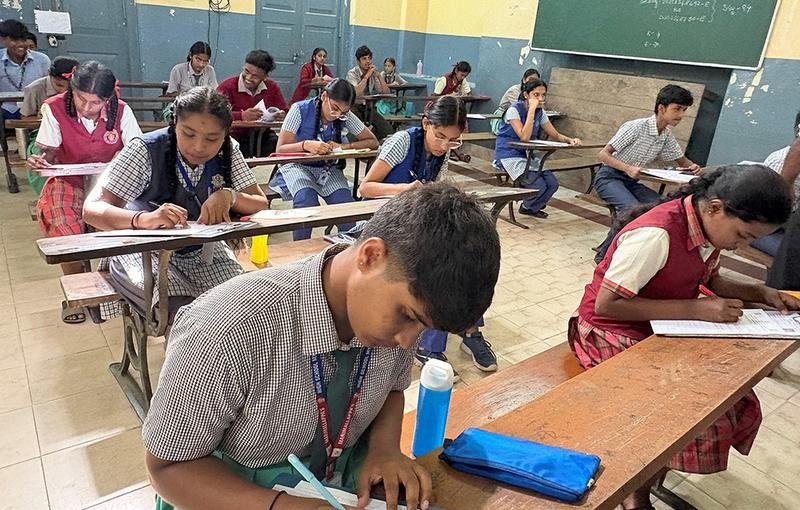
This is not a minor accounting gap. Samagra Shiksha is the financial backbone of public school education across India. It funds teacher training, school infrastructure, foundational literacy, and support for marginalised students. A shrinking approved budget at the state level directly impacts classrooms.
What the Budget Numbers Actually Say
The Ministry of Education’s allocation of Rs 1,39,289 crore for 2026-27 accounts for only 2.60% of the total Union Budget and falls far short of the 6% target promised under NEP 2020. School education has seen just a 6.34% increase, while Samagra Shiksha rose by only 2.06%, below inflation.
Samagra Shiksha remains the principal funding vehicle at Rs 42,100 crore for 2026-27, up from Rs 38,000 crore in the previous revised estimate. The government has presented this as a record allocation. Education policy analysts say the picture is far more complicated.
The Centre for Social and Economic Progress (CSEP) pointed to a structural shift underway. Between the 2019-20 actuals and the 2026-27 budget estimate, the share of model schools such as Kendriya Vidyalayas and PM-SHRI in the total Department of School Education and Literacy budget increased from 19% to 28%, while the share of Samagra Shiksha Abhiyan declined from 62% to 50%.
CSEP noted that model schools clearly matter, but not at the cost of general-category government and government-aided schools, which constitute nearly 74% of all schools and enrol around 60% of all students, yet continue to function with persistently constrained resources.
States Are Not Getting What They Are Owed
The funding problem runs deeper than central allocations. States are not receiving what they are entitled to, and what they do receive is often not fully spent.
Research by the Foundation for Responsive Governance (ResGov) found that in FY 2024-25, across all 36 states and UTs, only 62% of the approved Samagra Shiksha budget was utilised. Among states, utilisation was the lowest in Tamil Nadu at 23% and West Bengal at 24%.
A parliamentary standing committee report reviewed by Careers360 revealed a stark picture. Just 54.9% of the budget allocated to Samagra Shiksha Abhiyan had been utilised up to February in the 2025-26 financial year. Against a combined budget estimate of Rs 62,660 crore for five centrally-sponsored schemes, actual expenditure stood at Rs 32,296.54 crore barely 51.5% of the budget estimate.
The parliamentary panel was headed by Congress MP Digvijaya Singh and presented its findings to Parliament in March 2026.
Centre-State Tensions Over NEP Compliance
Part of the underspending is not accidental. Several opposition-ruled states have seen Samagra Shiksha funds withheld over disputes about NEP 2020 implementation.
Kerala General Education Minister V. Sivankutty stated in December 2024 that the Union government had withheld more than Rs 953 crore of Samagra Shiksha funds in 2023-24 and 2024-25 for non-implementation of the PM SHRI scheme. “The central government is using the centrally sponsored scheme Samagra Shiksha as a tool to take decisions on PM SHRI. The Centre has withheld Rs 953 crore 12 lakh for public education. This is a stance that completely renders the federal system proposed by the Indian Constitution irrelevant,” he said.
Tamil Nadu Chief Minister M.K. Stalin raised a similar alarm in 2024. On X, he wrote: “Denying funds to the best-performing states for refusing to bow to the NEP, while generously rewarding those who are not delivering on the objectives, is this how the Union BJP government plans to promote quality education and equity?”
Education Minister Acknowledges the Problem
The issue has not gone unnoticed by the government itself. Union Education Minister Dharmendra Pradhan recently held a detailed review meeting on fund release and utilisation under Samagra Shiksha Abhiyan. In a social media post, Pradhan said an integrated approach through the convergence of key schemes including SSA, PM-POSHAN, ULLAS, and PM-SHRI would be undertaken, ensuring greater coordination and impact across the school education ecosystem.
Pradhan added that there would be a renewed focus on the effective implementation of NEP 2020, with special emphasis on innovation, nutrition, skill development, sports, and arts, playing a pivotal role in nurturing empowered learners and building the human capital required for Viksit Bharat 2047.
The Structural Problem Behind the Numbers
Experts argue that the underspending reflects structural limits, not just state-level inefficiency. The Education for All in India platform noted that actuals often fall 10-15% short of budget estimates due to delays in fund releases, implementation bottlenecks, and unspent balances in schemes like Samagra Shiksha. Historical data shows actual expenditure in 2023-24 was around Rs 1,14,054 crore against a budget estimate of Rs 1,20,000 crore.
CSEP also flagged a dependency problem. Samagra Shiksha and PM POSHAN, which are critical for universal access and student retention, have seen only incremental increases of Rs 850 crore and Rs 250 crore respectively from 2025-26 budget estimates. Both schemes are now fully financed through education cesses, and this continued dependence on earmarked funds, rather than core budgetary support, limits the system’s flexibility to respond to emerging needs.
What It Means for India’s Children
KYS noted that Civil society groups have highlighted that 67,000 schools lack toilets and over 65 lakh students have dropped out, nearly half of them girls. These are not problems that will be solved by model school investments alone.
India’s NEP 2020 set a target of 100% gross enrolment ratio across all school levels by 2030. That target looks increasingly distant when the scheme designed to achieve it is losing budget share, seeing poor utilisation, and becoming a tool of political negotiation between the Centre and states.
For millions of children enrolled in ordinary government schools across India, the gap between budget speeches and actual classrooms keeps widening.
Clear Cut Education, Research Desk
New Delhi, UPDATED: June 03, 2026 01:00 IST
Written By: Ayushman Meena