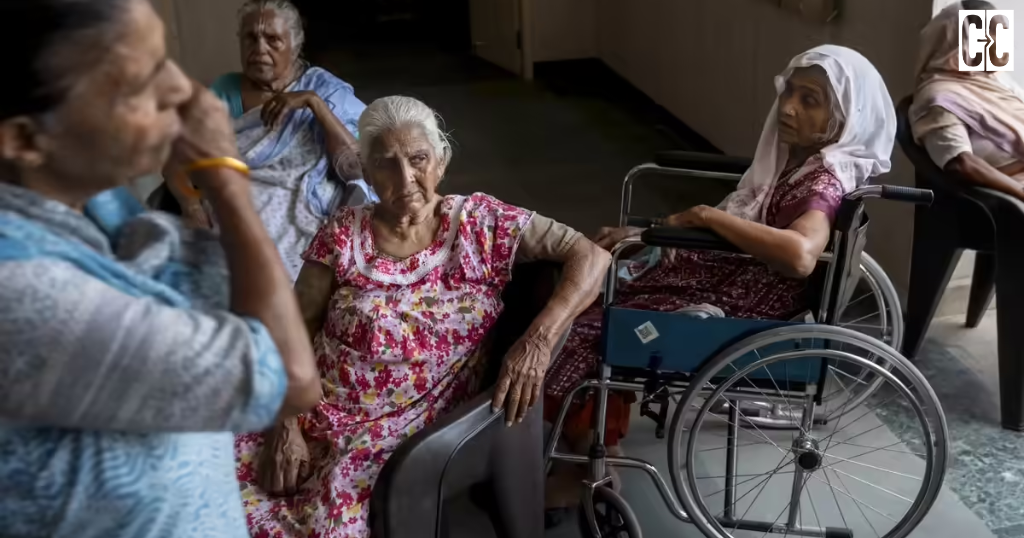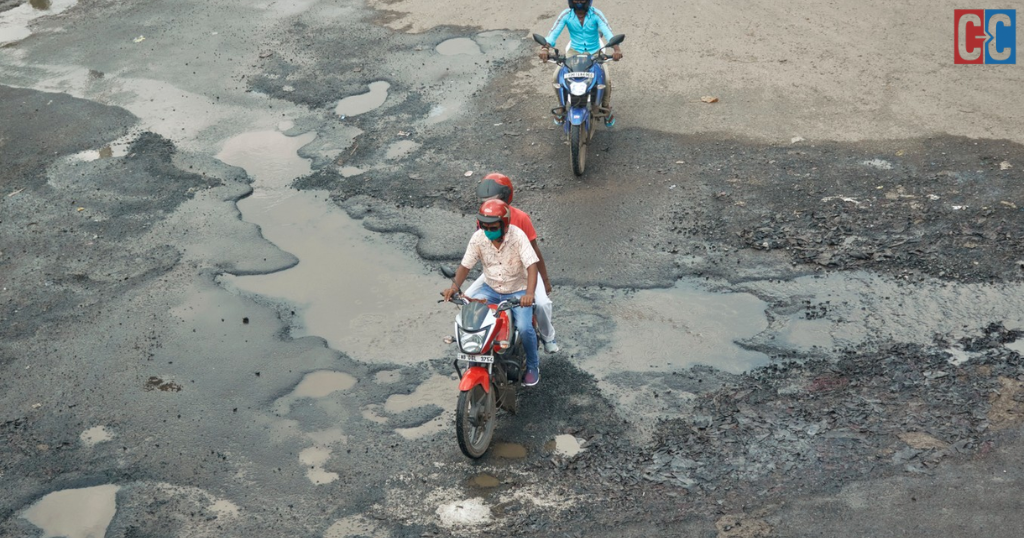
- India’s cities heavily depend on walking, yet poor footpaths and unsafe pedestrian infrastructure continue to put millions at risk.
- The article highlights 36,526 pedestrian deaths in 2024 and the gap between existing urban policies and their implementation.
- The Supreme Court’s 2026 ruling recognising safe, demarcated footpaths as a fundamental right could strengthen accountability for pedestrian infrastructure.
Who Are Indian Cities Built For?
A child in Tamil Nadu walks five minutes from his home to the main road and then continues down the road itself because there is no footpath. A woman in Delhi takes a shared auto to the nearest metro station, steps out, and navigates a broken slab-and-mud stretch for two hundred metres to reach the entrance. A man in Bengaluru walks his elderly mother to the government hospital for her follow-up appointment, half of it on the carriageway because the footpath has been colonised by parked motorcycles. A vendor in Kolkata pushes her cart down the road because the pavement, where it exists, has a utility cable box sitting in the middle of it.
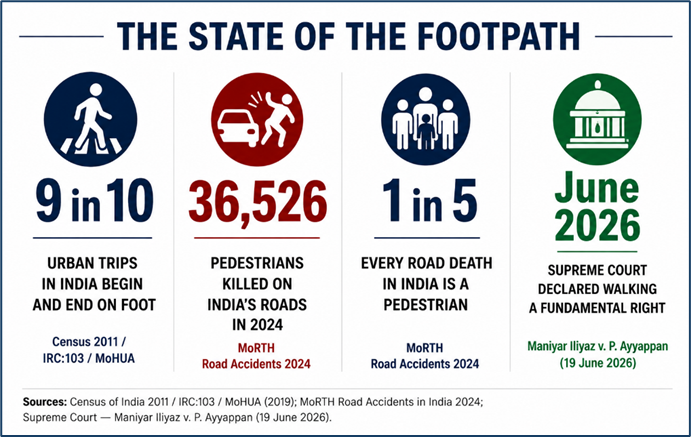
None of these are exceptional situations. They are the routine daily experience of hundreds of millions of Indians who walk. And walking, according to India’s own Census data, is how nine out of every ten urban trips begin and end.
When the Supreme Court of India declared in June 2026 that the right to walk on a safe, demarcated footpath is a fundamental right under the Constitution, the judgment was widely reported as a milestone. What it also was, if read carefully, was an admission: that after nearly two decades of urban mission programmes, national transport policies, and disability access laws, the government had still not managed to make India’s footpaths usable enough that courts were not being asked to intervene.
India Is Still a Walking Nation
The 2011 Census, which for the first time collected data on mode of transport to work, found that walking and cycling together accounted for nearly half of all work journeys among urban workers. The Indian Roads Congress, in its official guidelines for pedestrian facilities (IRC:103), notes explicitly that the data shows nine out of ten urban trips begin and end on foot.
This is not simply because India is poor. It is because cities are dense, distances are short, and walking is often faster than waiting for an auto, bus, or cab for the first or last stretch of any journey. Even people who use the metro walk to the station. Even people who take cabs are deposited at a gate and walk inside. Walking is not a residual mode for those who have no choice. It is the mode that holds every other mode together.
By 2030, India’s urban population is projected to cross 600 million. The walking population will grow with it. What will not grow, unless planned for, is the infrastructure to accommodate it. The MoHUA’s Complete Streets Design Workbook, published in 2019, acknowledges the problem directly: pedestrian and cycling infrastructure is consistently underfunded and underplanned relative to its actual use.
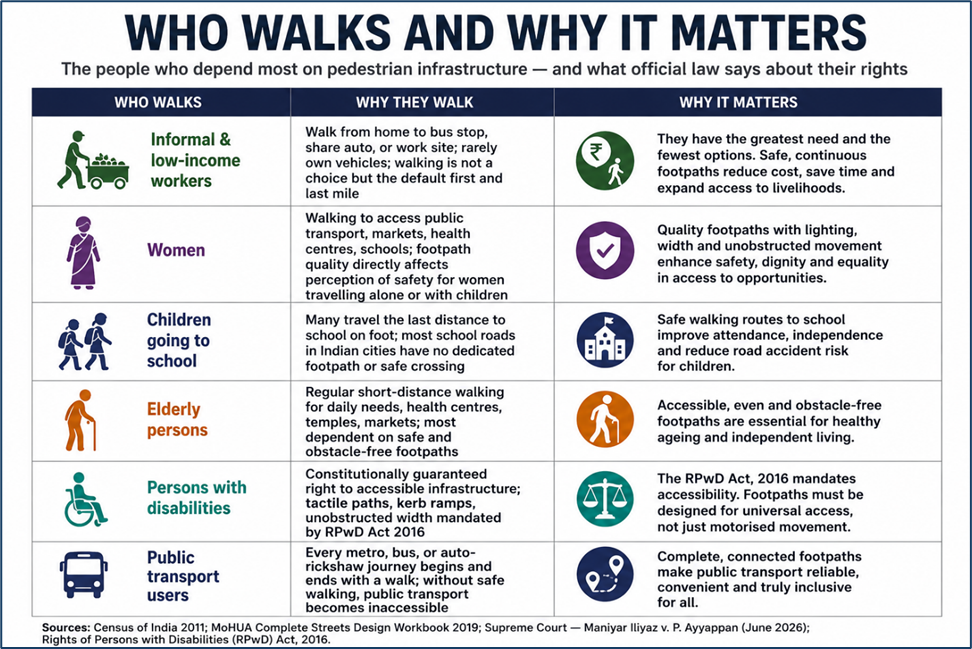
The table above describes a simple fact: the people who depend most on functional footpaths are precisely those who have the least political voice in decisions about how road budgets are spent. Flyovers and grade separators are highly visible. Footpaths are not. Broken footpaths generate no ribbon-cutting photographs.
36,526 Deaths in a Year
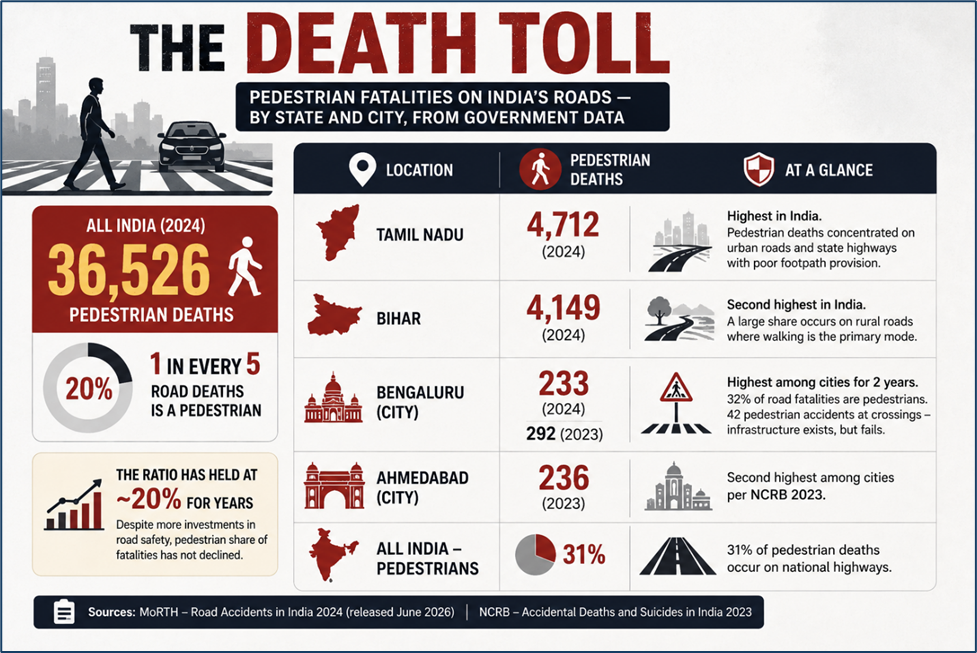
The Ministry of Road Transport and Highways released its Road Accidents in India 2024 report in June 2026. Among its findings: 1,77,175 people died on Indian roads in 2024. Of those, 36,526 were pedestrians. That is one pedestrian death every fifteen minutes, around the clock, every day of the year.[5]
Every fifth person who died on an Indian road in 2024 was on foot. The ratio has not dropped. It has stayed at roughly one in five for years, through multiple road safety programmes, through the Motor Vehicles (Amendment) Act of 2019, through Smart Cities, through AMRUT. The stubbornness of this ratio is itself a piece of evidence: the problem is not primarily behavioural, it is infrastructural. When there are no footpaths, pedestrians walk on roads. When pedestrians walk on roads designed for vehicles, pedestrians die.
Tamil Nadu recorded 4,712 pedestrian deaths in 2024 the highest of any state. Bihar recorded 4,149. Bengaluru was the deadliest city for pedestrians for two consecutive years, recording 292 deaths in 2023. Among those deaths, 42 occurred specifically at pedestrian crossings infrastructure that was present but failed to protect.
The MoRTH report itself recommends, as a direct response to these numbers, “stronger pedestrian infrastructure, safer crossings, and traffic-calming measures.” The recommendation sits in the same document that records the deaths. The gap between the recommendation and the reality is not a gap in knowledge. It is a gap in political priority.
“The right to walk is a fundamental right under Part III of the Constitution. The fundamental right to walk will take within its sweep the right to demarcated footpaths. These rights are primary and shall have priority over movement by motorised vehicles.
— Supreme Court of India, Maniyar Iliyaz @ Shaik Riyaz v. P. Ayyappan & Ors., 19 June 2026
The Laws That Already Exist
The striking thing about India’s footpath problem is not that there are no laws. There are several. The National Urban Transport Policy, first issued in 2006 and revised in 2014, explicitly mandated that urban road space be shared more equitably with people rather than vehicles, and directed all cities to prepare Comprehensive Mobility Plans that prioritise pedestrians and non-motorised transport.
The AMRUT Mission, launched in 2015 for 500 cities, listed footpaths, walkways, sidewalks, and foot overbridges as explicit funding categories. The Central Motor Vehicles Rules already bar parking on footpaths. The Rights of Persons with Disabilities Act 2016 mandates tactile paths, kerb ramps, and universally accessible pedestrian infrastructure under Sections 40 and 41.
The Indian Roads Congress has published technical guidelines (IRC:103) specifying minimum footpath widths, crossing standards, and pedestrian route ratio maximums. MoHUA has a Service Level Benchmark framework that grades cities on the quality of their pedestrian facilities.
None of this has been sufficient. The Supreme Court in May 2025 noted that the Union government had still not framed national guidelines on pedestrian protection, despite directing it to do so. By June 2026, the Court had moved from direction to declaration: walking is a fundamental right. Even so, the order that followed directing all states to formulate guidelinesdid not set a compliance deadline or an enforcement mechanism, beyond the implicit pressure of constitutional obligation.
LAWS, POLICIES, AND THE GAP BETWEEN THEM
What India’s central government frameworks mandate for pedestrian infrastructure and what has actually happened
| Policy / law | What it mandates | The implementation gap |
| National Urban Transport Policy 2006 / 2014 (MoHUA) | Explicitly mandates equitable road space for people over vehicles; directs Comprehensive Mobility Plans to prioritise pedestrians and non-motorised transport | Only 30 cities prepared CMPs as mandated; 15 UMTAs established against 53 million-plus cities; NITI Aayog noted implementation ‘far from satisfactory’ |
| AMRUT Mission 2015 (MoHUA) | Explicitly funds footpaths, walkways, sidewalks, foot overbridges, and cycling facilities in 500 mission cities | Independent assessments found footpath creation was among the lowest-priority components actually funded; bulk of allocations went to water, drainage, sewerage |
| IRC:103 — Guidelines for Pedestrian Facilities (Indian Roads Congress) | Establishes minimum footpath widths, crossing facility standards, pedestrian detour route ratio (max 1.5) | 2025 walkability index study: 60% of surveyed stretches did not meet IRC minimum width; 95% had discontinuities IRC standards are treated as guidelines, not enforceable minimums |
| MoHUA Service Level Benchmarks – Urban Transport | LoS framework grades cities on pedestrian facility adequacy, barrier-free access, intersection safety | Most Indian cities have never formally self-assessed against this framework; no public reporting of LoS scores for pedestrian infrastructure at city level |
| Central Motor Vehicles Rules (CMVR) | Explicitly bars parking on footpaths | Routinely unenforced; footpaths in most Indian cities are occupied by vehicles, hawkers, and construction material; Supreme Court noted this in May 2025 and June 2026 |
| RPwD Act 2016 – Sections 40 and 41 | Mandates tactile paths for visually impaired, kerb ramps, universally accessible pedestrian infrastructure | Supreme Court 2026: non-compliant footpaths are unconstitutional; yet local agencies ‘routinely build inaccessible infrastructure’ (Down to Earth 2026) |
| Supreme Court orders – May 2025 and June 2026 | Directed all states and UTs to frame pedestrian footpath guidelines; declared walking a fundamental right; ordered Centre to constitute National Road Safety Board | Centre had not framed national pedestrian guidelines as of May 2025 order; states instructed to draw from Bombay HC and Karnataka HC standards; compliance timeline not yet established |
Sources: MoHUA NUTP 2006/2014; AMRUT Guidelines 2015; IRC:103; MoHUA SLB Urban Transport; CMVR; RPwD Act 2016; Supreme Court May 2025 and June 2026 orders.
A City Is Only as Good as Its Footpaths
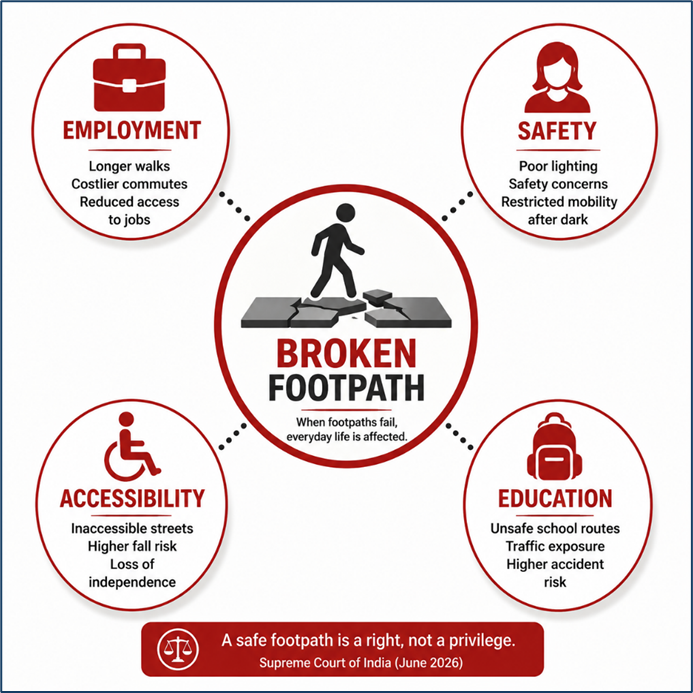
The equity argument for footpath investment is more straightforward than it might first appear. Poor households walk more than wealthy households. Women in Indian cities walk to access buses, autos, and shared transport that men with motorcycles do not need. Children walk to school on routes that no planning body has designed for their presence. The elderly walk to hospitals, to temples, to markets and in most Indian cities, they do so either on a surface unsuitable for a walking aid, or on the road itself.
The Supreme Court’s June 2026 ruling connected this equity argument directly to constitutional rights: safe streets, the Court said, uphold Articles 14, 15, and 21 together not just the right to life, but the right to equality and the prohibition of discrimination. A footpath inaccessible to a wheelchair user is not merely poor design. Under both the RPwD Act 2016 and the Court’s ruling, it is unconstitutional.
There is a climate and public health dimension to this as well. The MoHUA and NITI Aayog have both noted that good walking and cycling infrastructure reduces short vehicle trips, lowers urban emissions, and improves physical activity levels in cities. A city where walking is safe and comfortable enough to compete with two-wheeler trips for distances under two kilometres is a city with measurably lower particulate emissions. The footpath is not just transport infrastructure. It is, in a dense urban environment, also part of the city’s climate infrastructure.
What the Supreme Court Said in June 2026, and What Comes Next
The case that produced India’s most significant pedestrian rights ruling began with a death. A five-year-old child was walking to school with his father when a tanker struck and killed him. The road had no footpath. It had no pedestrian crossing. There was no infrastructure of any kind to suggest that a child walking to school on that road had been anticipated or planned for.
While adjudicating the family’s compensation claim, the Supreme Court moved beyond the immediate facts to examine the constitutional question. Its answer was unambiguous: the right to walk on a safe, demarcated footpath is a fundamental right. The rights of pedestrians are primary and take precedence over the movement of motorised vehicles. A footpath inaccessible to a person with a disability is unconstitutional. Every state and Union Territory must formulate guidelines for pedestrian-friendly footpaths, drawing from standards already laid down by the Bombay and Karnataka High Courts. The Centre must constitute the National Road Safety Board.
The ruling does not, on its own, build footpaths. Constitutional declarations require executive follow-through, and the history of pedestrian infrastructure in India is precisely the history of the gap between policy and execution. The NUTP has mandated pedestrian priority since 2006. The Supreme Court reiterated it in June 2026. The distance between those two dates is the measure of the problem.
What the June 2026 ruling does change is the legal terrain. States and local bodies that build or maintain non-compliant footpaths, that allow encroachments to stand, that do not install accessible infrastructure, are now explicitly in breach of a fundamental right. That creates a basis for public interest litigation that did not previously exist with the same constitutional clarity. Whether that basis is used and whether courts translate that use into enforceable orders against specific bodies will determine whether the ruling is a turning point or another waypoint on the same road.
What a City Built for People Would Look Like
The government’s own policy documents have answered this question, repeatedly and with reasonable clarity. The MoHUA’s Complete Streets Design Workbook (2019) describes streets designed around the movement of people, not vehicles. The NUTP mandates Comprehensive Mobility Plans that prioritise walking and cycling. AMRUT funds footpath infrastructure. The IRC:103 specifies the technical standards. The RPwD Act mandates the accessibility requirements.
The gap is not in knowledge. It is in accountability. Urban local bodies are responsible for footpath construction and maintenance but have limited technical capacity and face political pressure to prioritise road widening over footpath repair. There is no mandatory public reporting of Service Level Benchmark scores for pedestrian infrastructure, so no city government is formally accountable for the state of its footpaths. There is no national registry of footpath coverage or quality. The Supreme Court’s June 2026 order that the Centre place its pedestrian policies “on record” revealed that no consolidated national framework existed.
What would change this is not complicated in its description, even if it is difficult in its execution: cities where the persons who plan roads must count walking trips, not just vehicle trips; where local bodies are graded and publicly ranked on pedestrian infrastructure quality; where the accessibility standards of the RPwD Act are audited rather than assumed; where the national pedestrian guideline the Supreme Court has ordered is actually written, notified, and enforced with the same seriousness as vehicle emission standards.
India is building metro systems in seventeen cities and expressways across the country. These are real investments in mobility, and they matter. But the person who takes the metro still has to walk to the station. The person who lives near an expressway but has no car still has to walk to a bus. Mobility does not begin with a metro station or a flyover. It begins where every journey in India actually begins: a few steps outside the front door, onto whatever is – or is not – beneath the feet.
Clear Cut Research Desk
New Delhi, UPDATED: August 22, 2026 09:00 IST
Written By: Shivangi Misra
Designation: Assistant Manager – MLE at Devinsights