

- The US Senate passed a 50–48 bipartisan war powers resolution urging President Trump to remove US forces from hostilities with Iran, marking the first successful passage after ten attempts.
- Although the resolution is non-binding, it reflects growing congressional concern over executive war powers and declining bipartisan support for the ongoing conflict.
- Attention now shifts to the Pentagon’s proposed $80 billion funding request, which could become Congress’s most significant opportunity to influence the war’s future.
THE TENTH TIME WAS THE CHARM
Some legislative votes pass on the first attempt. This one took ten. On Tuesday, June 23, 2026, the United States Senate voted 50-48 to adopt a war powers resolution directing President Trump to remove US armed forces from hostilities with Iran. The first time in ten separate attempts since February that such a measure has actually passed the chamber, after Senate Democrats spent months methodically chipping away at Republican unity on a war most of the public, by every available measure, opposes.
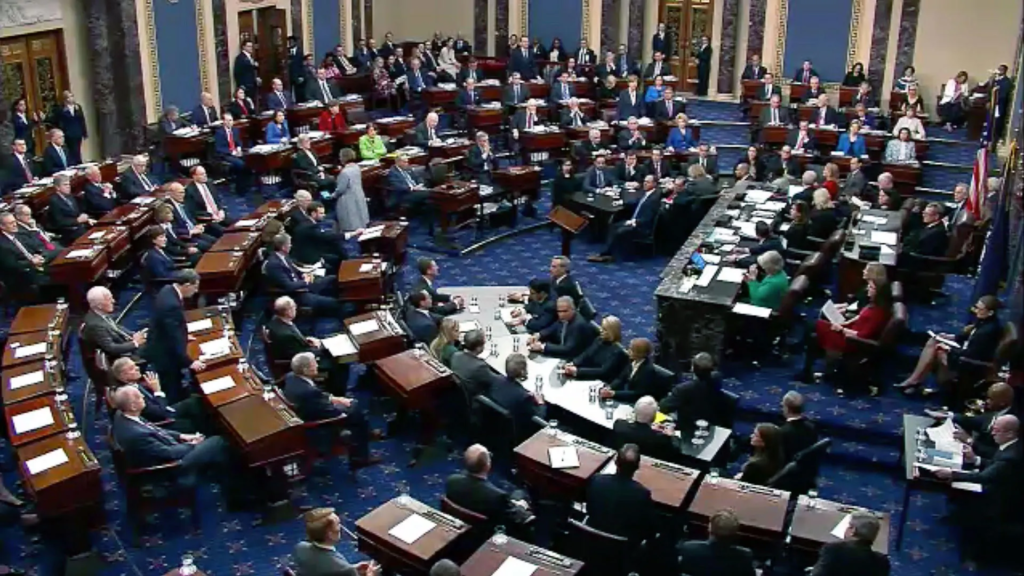
The resolution itself carries no binding legal force and will not be sent to the White House for a signature. Congress cannot force troop withdrawal. But the vote represents something arguably more significant in institutional terms: a bipartisan majority in the Senate publicly, formally, on the record, telling a sitting president his military campaign lacks congressional support.
WHO CROSSED THE AISLE, AND WHY IT MATTERS
The 4 Republicans who joined Democrats were Susan Collins of Maine, Lisa Murkowski of Alaska, Rand Paul of Kentucky and Bill Cassidy of Louisiana. They represent a politically telling mix. Paul and Murkowski have voted for similar measures before, reflecting longstanding institutional or libertarian skepticism of unchecked executive war powers. Cassidy’s vote, however, marked his first time supporting such a resolution, and came just days after he lost his Louisiana Republican primary to a Trump-endorsed challenger. A sequencing that several Democratic senators, including Tim Kaine, noted explicitly without claiming to know Cassidy’s precise motivation.
The absence of two other Republicans who have previously voted against advancing similar resolutions meaningfully altered the arithmetic. Only one Democrat, John Fetterman of Pennsylvania, voted against the resolution, as he has consistently done throughout this entire ten-vote sequence.
THE WAR’S TOLL AND THE FUNDING FIGHT AHEAD
The underlying conflict, which the resolution describes as having begun with US-Israeli airstrikes on Tehran on February 28, 2026, has now stretched more than 80 days, according to Senate Minority Leader Chuck Schumer’s own framing on the floor. The vote arrives precisely as the Pentagon is requesting approximately $80 billion from Congress, largely to replenish munitions and stockpiles depleted by the sustained campaign. The funding fight, not the symbolic resolution, may end up being the more consequential leverage point for lawmakers genuinely seeking to constrain the conflict’s continuation.
President Trump, according to multiple reports, met with GOP senators at the Capitol the following day in a notably tense session, at one point sternly telling Senator Cassidy to sit down during an exchange over the vote. Cassidy later told reporters he ‘lost his temper’ in response and matched the president’s tone, in an unusually public display of friction between a sitting president and members of his own party’s Senate conference.
WHAT GENUINE OVERSIGHT REQUIRES NEXT
A symbolic resolution that carries no binding force is, by itself, an insufficient check on executive war-making power and lawmakers on both sides of this vote know that. The resolution’s real value lies in what it signals about the durability of congressional resistance heading into the upcoming $80 billion funding request: if the same coalition that produced Tuesday’s 50-48 vote holds together when actual appropriations are on the table, Congress will have demonstrated it can exercise the power the Constitution assigns it, not merely register disapproval it lacks the will to enforce.
Congress’s silence for 80-plus days before this vote passed should prompt serious institutional reflection regardless of one’s view on the underlying Iran policy. The constitutional question Tim Kaine raised should not require 10 attempts and a senator’s primary defeat to produce a single, non-binding majority vote. The upcoming funding debate is where that institutional resolve will actually be tested.
Clear Cut Research Desk
New Delhi, UPDATED: June 28, 2026 09:00 IST
Written By: Tanmay J. Urs