- Jal Jeevan Mission has expanded rural tap coverage to over 82%, but ensuring reliable, quality and regular water supply remains the bigger challenge.
- JJM 2.0 shifts the focus from building infrastructure to service delivery, maintenance, accountability and sustainable water sources.
- CSR can help bridge the last-mile gap through water-quality testing, technical training, digital monitoring and O&M support.
At the time the Jal Jeevan Mission was launched from the Red Fort in August 2019, 16.7 percent of India’s 193.5 million rural households had a working tap connection. By March 2026, this had jumped to 81.6 percent, adding 125.5 million household connections in less than seven years – one of the largest rural infrastructure rollouts anywhere in the world. The WHO estimates that 55 million hours are saved daily from water fetching; the mission has declared 277,000 villages Har Ghar Jal, or water in every home. It is, by any standard, a tremendous success. It is also, in terms of actual function, an unfinished one, going by its own data.
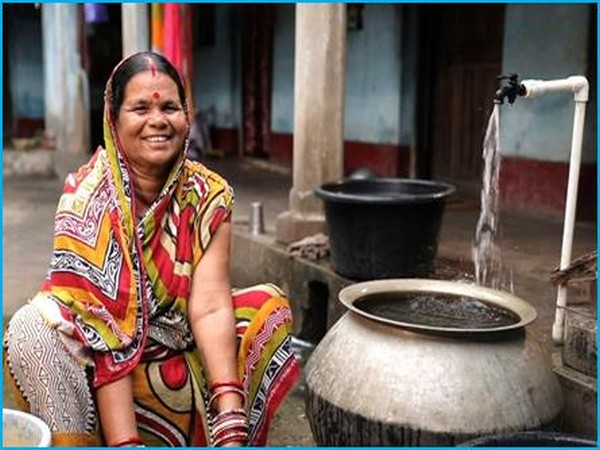
The Gap Between a Tap and Clean Water
A 2024 Functionality Assessment covering nearly 19,812 certified Har Ghar Jal villages across 761 districts found that while 98% of households had a physical tap connection. Only 3 in 4 households were actually receiving water that met the mission’s standards for quantity, quality, and regularity of supply. That gap, between a pipe being installed and water reliably flowing through it, is precisely where JJM 2.0 has now focused its second phase.
From Infrastructure to Service Delivery
JJM 2.0, as approved by the Union Cabinet in March 2026, changed the mission from an infrastructure-focused approach to one focused on service delivery. Revised: Increased the model to 8.69 lakh crore from 3.60 lakh crore previously, and raised the central government’s share from 2.08 lakh crore in the original 2019 budget to 3.59 lakh crore, adding 1.51 lakh crore. As part of the revised model, a GP can be declared Har Ghar Jal only after a robust mechanism for operation and management is in place. This is the one policy reform that directly targets the conclusion drawn from observations that installing infrastructure does not necessarily ensure a consistent water supply.
Governance and Accountability Under a State Subject
Water is a state subject by nature, and C. R. Patil, Union Minister of Jal Shakti, has repeatedly stated in Parliament that most problems stem from the state authorities responsible for implementation, despite the Centre bearing most of the project costs. Of the nearly 18,000 complaints filed regarding the mission, action was taken against over a thousand officials for irregularities, implying that, if inconsistently, the enforcement apparatus works.
Where CSR and Private Capital Can Add Value
Corporate water CSR in India has historically concentrated on watershed restoration, groundwater recharge, and rainwater harvesting rather than last-mile piped-water reliability, largely because O&M work is less visible and less easily attributed to a single donor than a new borewell or check dam. As JJM 2.0’s O&M mandate becomes a hard gate for certification, there is a clear, underexploited opening for CSR capital to fund technical training for Village Water and Sanitation Committees, water-quality testing infrastructure at the panchayat level, and digital monitoring tools that can flag supply failures before they become multi-week outages.
Groundwater as the Mission’s Silent Partner
Piped connections mean little if the groundwater feeding them keeps falling. The government has begun redirecting a substantial 65% share of MGNREGA funds to water-scarce regions to revive groundwater levels, recognizing that source sustainability, not just pipe-laying, ultimately determines whether JJM’s taps keep running. Complementary programmes such as the Atal Ground Water Scheme and the Amrit Sarovar initiative, which have revived numerous traditional water bodies nationwide, form the less-visible infrastructure layer beneath the household tap. CSR programmes focused narrowly on visible tap installations, without contributing to the underlying source-sustainability layer, risk funding infrastructure that runs dry within a few seasons.
The Way Forward
Counting the taps was the less interesting component of this mission; counting the reliable litres which actually reach the household at the tap, every single day, at the specified standard, is more meaningful and more difficult. JJM 2.0’s own design, which makes the functional certification contingent on the presence of operational maintenance facilities, is an indirect acknowledgment that phase 1 was disproportionately focused on visible infrastructure. This year and next, the accountability test is simple: states must release village-level functioning figures, not merely tap coverage figures, and CSR in the water sector must chase the O&M gap, not construction. It’s no solace to a house that runs dry at least three days a week that it now has 82% tap coverage.
Clear Cut Wash Desk
New Delhi, UPDATED: August 23, 2026 10:00 IST
Written By: Tanmay Urs