

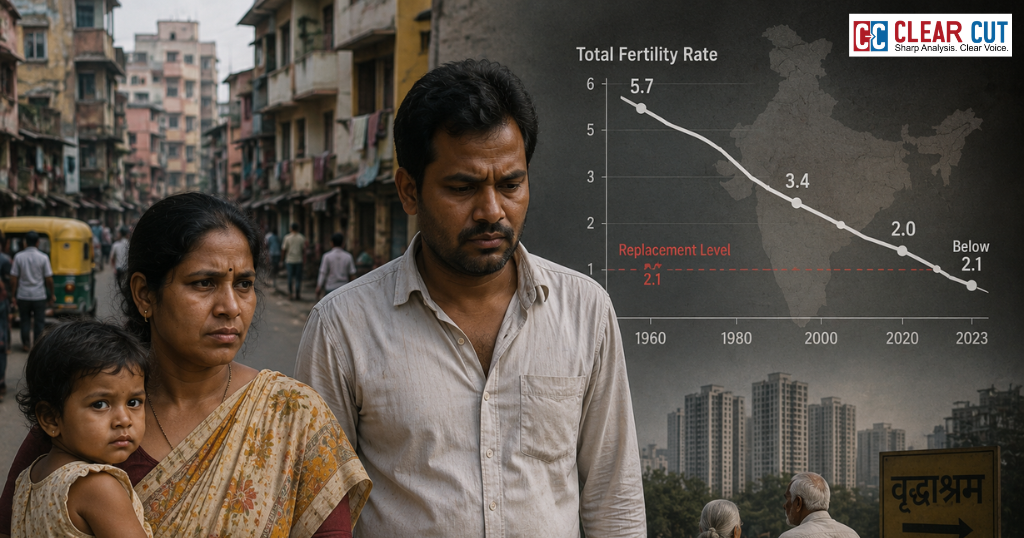
- India’s Total Fertility Rate (TFR) has fallen to 1.9, dropping below the replacement level for the first time and marking a significant demographic shift in the country.
- Improvements in education, healthcare, women’s empowerment, and urbanization have contributed to smaller family sizes, though fertility rates still vary across states and between urban and rural areas.
- While India’s population will continue growing due to population momentum, the country must prepare for future challenges related to an ageing population and a changing workforce.
In the context of India’s population over several decades, there is only one factor that has been a recurring topic of debate – growth. From overcrowding to public facilities, all issues related to India’s population revolved around one idea, namely, that India’s population will continue to grow at an unprecedented pace.
All that is set to change.
According to the Registrar General of India’s Sample Registration System (SRS) Statistical Report 2021, India’s Total Fertility Rate (TFR) in India has dropped to 1.9, marking the country’s entry into an era where the TFR falls below the replacement level rate of 2.1 for the first time.
This constitutes a new chapter in India’s demographic history.
An Impressive Change
The fall has been impressive. Whereas, in the 1970s, an average woman in India bore more than five children (as per World Bank Data: Fertility Rate, Total (Births per Woman) – India), today she gives birth to less than two children. This is due to the improvement made over decades in several fields such as education, healthcare, women empowerment, and family planning services.
Some of the reasons behind this transformation include:
Increased schooling years for women and employment in the job market by more women.
Migration of people from villages to urban areas because living and bringing up children in urban areas is more expensive.
Improved healthcare services that result in lower rates of death among babies and children and increased life expectancy for parents.
The Urban-Rural Disparity
Although the national scenario indicates reduced fertility rates, this phenomenon does not hold true for the entire nation.
The SRS Statistical Report 2021 estimates for urban India, the fertility rate stands at 1.5, indicating that it has crossed the replacement point. For rural India, however, the fertility rate remains 2.1, exactly at replacement levels.
Hence, such an imbalance shows the influence of economic factors, education, and lifestyle on the number of offspring. The people living in urban areas decide against marrying and giving birth to numerous children due to escalating cost of living and lack of room. In contrast, those in rural areas maintain their pace depending on economics and social trends despite declining fertility rates.
Diverse States, Diverse Realities
The demographic transition is happening at different rates in various states in India.
The SRS Statistical Report 2021 shows that currently, there are only six states that are higher than the threshold level. The fertility rate in the state of Bihar is very high compared to other states with a record high of 2.9 births per woman, while the lowest fertility rate was observed in Delhi at 1.2. States like Kerala, Tamil Nadu, and West Bengal have achieved very low fertility rates.
Why Does It Matter?
States that have a young age structure will continue to benefit from workforce growth, while the low-fertility states will start facing issues related to ageing much faster.
Is the Population in India Expected to Decline?
No, it is not.
Although the average family size in India is shrinking, the population of India will keep growing for many years because of a very youthful generation that entered the reproductive stage. This phenomenon is referred to as the “population momentum.”
Over the coming years, however, population growth will decrease and ultimately reverse.
Future Opportunities and Challenges
With fewer births come opportunities and difficulties.
For example, lower numbers of children in a family may give families the opportunity to provide for the needs of their offspring through higher levels of education, healthcare, and other important forms of care. It may be easier to enhance quality of life in government-provided services as population growth slows.
Other challenges await us in the future.
With fewer births comes fewer individuals to join the workforce. In the future, owing to decreased fertility levels, the Indian workforce will decline as the elderly population grows. More challenges could arise in caring for these individuals.

This problem is currently being faced by Japan, South Korea, and other nations in Europe. India has an opportunity to get ready in advance.
Strategies that help women participate in the workforce, increase productivity, enhance healthcare services, and plan for ageing will be more significant.
A New Era of Demographics
There is no cause for alarm when India’s fertility rate becomes below the replacement level. Neither is it a mere statistical figure.
It shows a nation that has gone through profound change in terms of socio-economic conditions. Improved education, enhanced healthcare services, urbanization, and altered goals have transformed the mind set of Indians.
What India is facing today is no longer dealing with a fast-growing population. Instead, it is planning for a future marked by slower growth and ageing of the population.
It is high time India moved into the next phase of its demographic saga.
Clear Cut Research Desk
New Delhi, UPDATED: June 12, 2026 05:00 IST
Written By: Mohita Bansal