

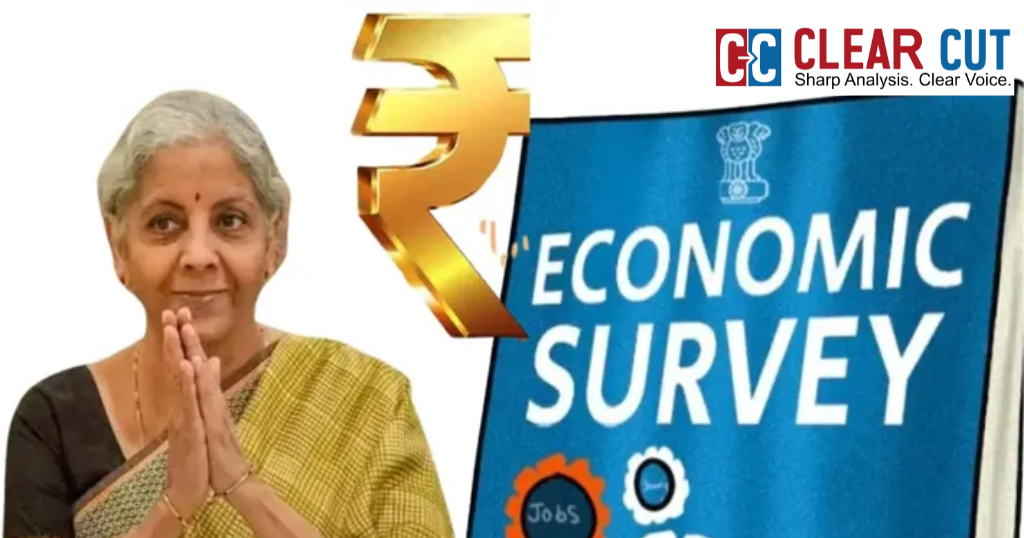
Union Finance Minister Nirmala Sitharaman tabled the Economic Survey 2025–26 in the Lok Sabha on Thursday, setting the tone for the Union Budget discussions and offering a comprehensive snapshot of India’s economic health. Prepared by the Economic Division of the Department of Economic Affairs under the supervision of Chief Economic Adviser (CEA) V Anantha Nageswaran, the Survey presents the government’s official assessment of macroeconomic trends, structural shifts, and the outlook for the coming fiscal year.
At a time of global uncertainty marked by geopolitical tensions, slowing trade, and volatile financial markets, the Survey strikes a note of cautious optimism. It underscores India’s resilience and sustained growth momentum, even as it flags the need for policy discipline and continued reforms.
Growth Outlook: Strong but Moderating
One of the headline takeaways of the Economic Survey 2025–26 is India’s growth projection. Real GDP growth for 2026–27 is estimated to lie in the range of 6.8% to 7.2%, slightly lower than the 7.4% growth estimated for the current fiscal year. While this moderation reflects a normalization after post-pandemic recovery highs, the Survey notes that India remains among the fastest-growing major economies globally.
The growth momentum, according to the Survey, is being driven by robust domestic demand, steady capital formation, and improving balance sheets of banks and corporates. Public capital expenditure continues to play a catalytic role, crowding in private investment and strengthening medium-term growth prospects.
Inflation: Anchored and Under Control
A key positive highlighted in the Survey is the containment of inflation. Headline inflation has remained largely within the Reserve Bank of India’s tolerance band, supported by proactive monetary policy and improved supply-side management. The Survey points out that core inflation has remained subdued, signalling easing cost pressures and better alignment between demand and supply.
This anchoring of inflation has provided macroeconomic stability and helped protect household purchasing power. The Survey also notes that targeted government interventions—especially in food supply management—have played a crucial role in mitigating price volatility during global shocks.
External Sector: Resilient Amid Global Headwinds
Despite a challenging global environment, India’s external sector has shown resilience. The Survey highlights comfortable foreign exchange reserves, manageable current account dynamics, and steady capital inflows. Services exports, particularly IT and business services, continue to provide a strong buffer against fluctuations in merchandise trade.
However, the Survey cautions that risks remain, including slowing global growth, disruptions in global supply chains, and uncertainty in energy markets. It calls for sustained diversification of export markets and products to strengthen India’s external resilience.
Fiscal Position and Public Finances
On the fiscal front, the Economic Survey underscores the government’s commitment to fiscal consolidation without compromising growth. Improved tax buoyancy, aided by GST stabilization and better compliance, has supported revenue generation. At the same time, rationalization of expenditure and a focus on quality spending—especially capital expenditure—have helped maintain fiscal discipline.
The Survey reiterates that sustained fiscal prudence is essential to create space for counter-cyclical interventions in the event of external shocks.
Employment, Productivity, and Structural Reforms
Employment generation and productivity enhancement emerge as critical themes in the Survey. It notes gradual improvements in labour market indicators, supported by formalization, digital platforms, and infrastructure-led growth. The Survey emphasizes that India’s demographic dividend can only be realized through continuous skilling, higher female labour force participation, and labour-intensive manufacturing growth.
Structural reforms in areas such as logistics, energy transition, digital public infrastructure, and financial sector deepening are identified as key enablers of long-term competitiveness.
The Road Ahead
In conclusion, the Economic Survey 2025–26 presents a narrative—one that recognizes India’s economic strength while acknowledging emerging challenges. With growth projected to remain robust, inflation under control, and macroeconomic fundamentals stable, the Survey reinforces confidence in India’s medium-term economic trajectory.
However, it also underlines that sustaining high growth will require policy consistency, reform momentum, and careful navigation of global uncertainties. As the country prepares for the Union Budget, the Survey serves as a crucial backdrop—highlighting that India’s economic story remains strong, but one that must be nurtured with prudence, inclusivity, and strategic foresight.
Clear Cut Research Desk
New Delhi, UPDATED: Jan 30, 2026 02:20 IST
Written By: Nidhi Chandrikapure