

India’s Youth Unemployment Crisis: When Job Seekers Stop Looking for Jobs
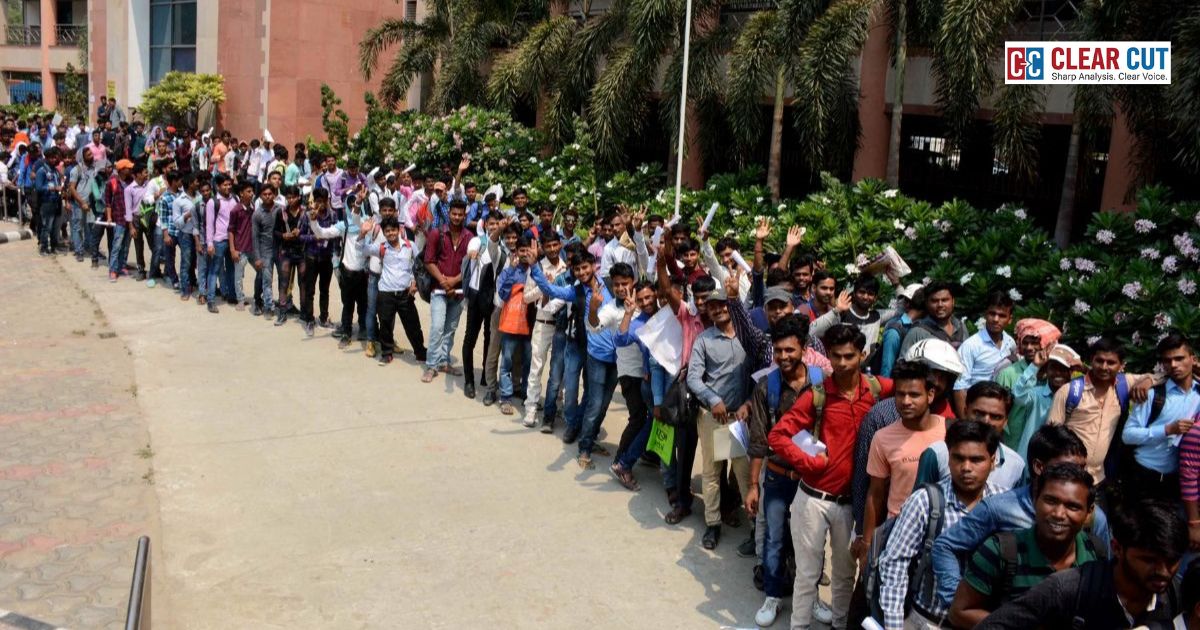
India’s labour market is going through a major crisis that is getting worse day after day. There are millions of young Indians who either can’t find appropriate work or have become so disappointed that they have stopped looking for work altogether. The change, from unemployment to discouragement, shows that there is a structural problem in the way jobs are created and counted in the economy which contradicts the story of job growth that is often used to explain policy success.
Lying at the heart of this crisis are two worrying statistics: recent estimates suggest that approximately 28 million educated young people in India are vigorously looking for jobs, while somewhat shockingly, nearly 100 million-mainly women-have stopped looking for work altogether, thereby becoming discouraged workers. This means they are no longer counted as part of the labour force because they are no longer actively seeking employment, even though they want to work.
Understanding Discouraged Workers
The discouraged worker is a term used by economist statisticians to refer to those workers who are both willing and available to work but are not searching due to a perceived lack of job opportunities. This is quite disturbing since it not only shows unemployment but also hopelessness. It shows a lack of morale in the labour force.
Historically, India’s headline level of unemployment has looked quite low, when measured by methods such as Periodic Labour Force Survey, or PLFS, for example. According to the labour force numbers, its unemployment numbers hover between low single numbers, sometimes below 5 percent. According to independent analysts, though, this underestimates the problem because this measure would include, for example, unpaid family workers, who would be classified under the “employed” categories, despite doing minimal work, apart from excluding those who dropped out of the workforce because they stopped looking for work.
This poses a methodological problem, in that the official statistics may overestimate or misrepresent the situation: an individual working a few hours a week in family or informal employment may be counted as employed, even though they are not earning sufficient income to be in a sound economic position or to be using their education and skills effectively.
Demographic Dividend vs. Labour Market Realities
For decades, demographers and policymakers hailed India’s youthful population as a potential demographic dividend-a situation where a large working-age population drives rapid economic growth. Yet, for this dividend to materialize, the economy needs to generate enough productive and decent jobs. The failure to do so means that the growing workforce instead becomes a burden-or worse, a disappointed generation stuck on the side-lines.
Several structural issues contribute to this disconnect between demographics and employment:
1. Slow Job Creation Compared to the Growth of the Labour Force: Even though the economy has grown over the past years, job creation has not kept up with the growth of the labour force. Sectors such as manufacturing have not grown quickly enough to accommodate the increasing labour force.
2. Skill Mismatch and Quality of Jobs: A substantial number of young individuals in the Indian demographic have acquired education, but skills remain mismatched as far as the job requirements of the employers. A remarkably small percentage of the labour force has undergone formal training in the area of skills.
3. Gender Disparity: Women are overrepresented in the number of discouraged workers. Social attitudes, lack of opportunities, gaps in wages, and other constraints limit the employment participation rate of females and increase their numbers as discouraged workers, thereby hampering gender equity, as well as denying the economy access to a large segment of its human resource pool.
Consequences of Discouragement
The consequences of discouraged workers are significant. For the individual, the absence from the job market affects the person’s financial security. It also impacts the person’s lifetime income and the person’s well-being. It also affects the person psychologically. It affects the person’s confidence and aspirations. It affects the young people who have been in school for many years in the hope of a stable job.
On the economy, the sheer number of discouraged workers can be limiting to the level of consumer expenditure growth in the country, as well as the development of human capital. By extension, the higher the number of discouraged workers, the greater their contribution to inequality in the country.
Policy Implications and the Path Forward
To overcome this problem, multiple strategies must be employed. First, labour statistics with more openness and inclusivity are needed so that decision-makers can grasp the reality concerning employment and discouragement. Second, enhancing employment generation by means of sectorial diversification, entrepreneurship, or investments in more labour-intensive sectors would assist in absorbing the rising labour supply.
Additionally, enhancing accessibility to quality skill development opportunities, aligned with market requirements, would also help to bridge the gap between education and employment. Equally critical is the need for the creation of the right environment for women to be part of the workforce with safe working environments and support systems in place.
Clear Cut Livelihood Desk
New Delhi, UPDATED: Dec 23, 2025 04:22 IST
Written By: Ayushman Meena


I read this piece of writing completely on the topic of the comparison of most
up-to-date and previous technologies, it’s awesome article.
Thank you