
The Broadcaster That Lost Its Audience and Found a Poet
There is a specific kind of institutional crisis that is harder to quantify than financial loss but far more existential: the loss of audience trust. Doordarshan, India’s national television broadcaster, was once the country’s only screen. It shaped the cultural imagination of three generations. It broadcast the nation’s first news, its first cricket, its first serial. It also, when cable and satellite arrived and private channels began competing for attention with higher production values and editorial freedom, steadily lost the plot. By the mid-2010s, Doordarshan was a broadcaster that people watched when they had no other choice.
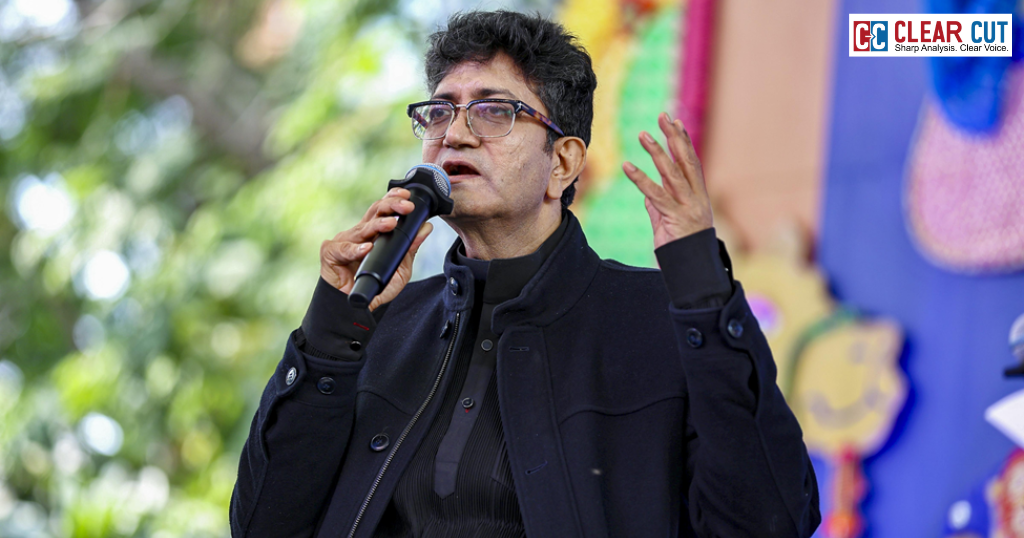
On May 2, 2026, the Ministry of Information and Broadcasting appointed Prasoon Joshi. He is a lyricist, writer, advertising legend, and former CBFC chairperson. And now, he is appointed as the new Chairperson of Prasar Bharati, India’s statutory autonomous public broadcaster, which oversees both Doordarshan and All India Radio. The appointment filled a vacancy that had existed since December 2025, when former chairperson Navneet Kumar Sehgal resigned.
Who Prasoon Joshi Is and Why the Choice Is Significant
Prasar Bharati oversees Doordarshan (national TV) and All India Radio — one of the world’s largest radio networks. The new Waves OTT platform extends free-to-air content to digital audiences. Established 1990, operational 1997; Joshi assumes charge May 2026.
[PIB / MIB / Manorama Yearbook 2026]
Prasoon Joshi is not a bureaucrat. He is not a media executive in the conventional sense. He is the lyricist who wrote Taare Zameen Par’s title track. He is the advertising creative who built campaigns that shaped how Indians think about family, nation, and identity. He was CEO of McCann World Group India and Chairperson of McCann World Group Asia Pacific. As CBFC chairperson since 2017, he navigated one of India’s most contentious cultural governance roles with a combination of firmness and creative sensitivity that earned him respect across the political spectrum.
Union Minister Ashwini Vaishnaw’s statement at the appointment was unusually poetic for a government press release: “Prasoon ji is a rare creative spirit celebrated across the world… yet his heart beats unmistakably for India. His words carry the fragrance of our soil, and his vision reflects the timeless essence of our culture.” The language signals what the appointment is for: not administrative consolidation, but creative reinvention.
What Prasar Bharati Actually Needs
Prasar Bharati’s challenges are structural, financial, and editorial simultaneously. AIR reaches over 90% of India’s geographic area but competes with private FM stations and podcast platforms for urban listeners and with local community radio for rural ones. Doordarshan’s challenge is even more acute: it operates in a media environment where OTT platforms, social media reels, and private news channels compete for the same evening hours, with dramatically higher production budgets and algorithmically optimised content strategies.
The Waves OTT platform, launched by Prasar Bharati to provide free-to-air streaming, is the right strategic direction: making public broadcasting available where audiences are rather than only where the transmitter reaches. But OTT success requires content that people choose to watch when they have alternatives. That is the creative challenge. And it is precisely why a creative professional at the helm is not merely symbolic; it is structurally appropriate.
The Accountability Test: Creative Leadership Must Deliver Editorial Standards
The history of creative professionals appointed to public institutions in India is mixed. Creative vision without institutional governance produces content energy without structural stability. Joshi’s most important rapid decision will be the editorial framework he sets up for Doordarshan News: will it move toward independence, transparency, and the kind of public interest journalism that justifies the claim of a ‘public’ broadcaster? Or will it remain the government’s primary information channel?
AIR’s rural reach and multilingual programming, broadcasting in 23 languages and 179 dialects (Prasar Bharati), is genuinely extraordinary and deeply undervalued. A chairperson with creative instinct must recognise that AIR’s greatest asset is not its infrastructure but its linguistic breadth. Investing in the creation of culturally resonant, locally produced content in those 179 languages is the most powerful act of public broadcasting that anyone in Joshi’s position could authorise.
Public Broadcasting as Cultural Public Good
Prasoon Joshi knows something about reaching people. His lyrics have been sung at weddings, played in hospitals, and hummed in village courtyards. His advertising work helped sell products and ideas to 1.4 billion people across every income level. The question now is whether he can take that understanding of what resonates with India’s people and apply it to the most important and most neglected public institution in the country’s media landscape.
Doordarshan and AIR can be great again. Not in the monopoly sense, but in the public-service sense: trusted, relevant, multilingual, editorially independent, and capable of telling the stories that commercial media has no financial incentive to tell. That is the mandate of a public broadcaster. Give Joshi the editorial autonomy to pursue it. Then hold him accountable for whether he does.
Clear Cut Review, Research Desk
New Delhi, UPDATED: June 01, 2026 01:00 IST
Written By: Tanmay J Urs