

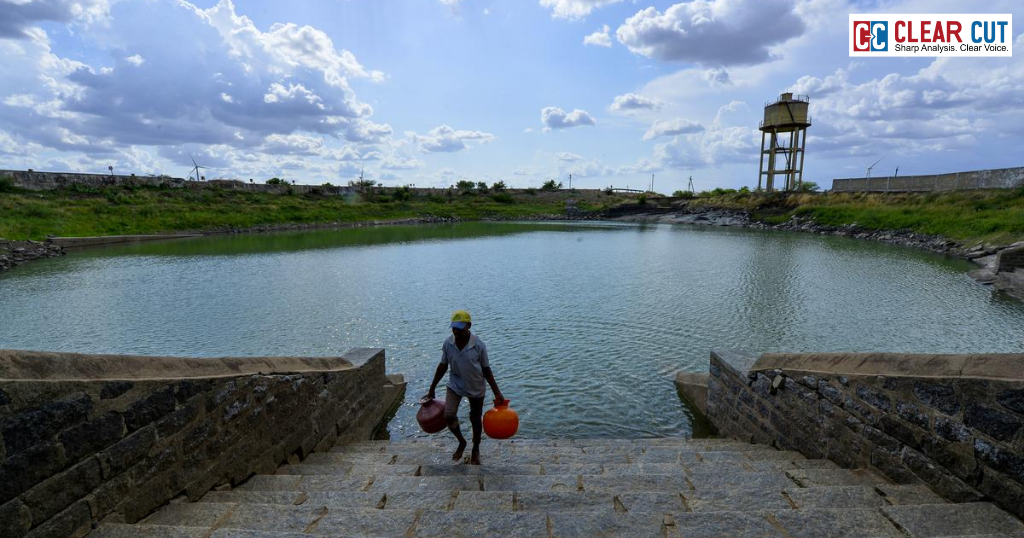
A viral video circulating on social media platforms highlighting young girls exposing themselves to danger in fetching water amid soaring temperatures in Khargone, Madhya Pradesh, has reignited discussions about the issue of rural water scarcity in India. Although great strides have been made through the Jal Jeevan Mission, much still needs to be done.
Access to Water in Rural India
A viral video from Madhya Pradesh’s Khargone district is once again forcing people to confront a harsh reality many villages still live with. In extreme heat, small girls were seen climbing dangerous rocky paths to collect water for their families. The video has triggered fresh online discussions around Rural water shortages, failed handpumps, Infrastructure gaps, and implementation challenges under the Jal Jeevan Mission.
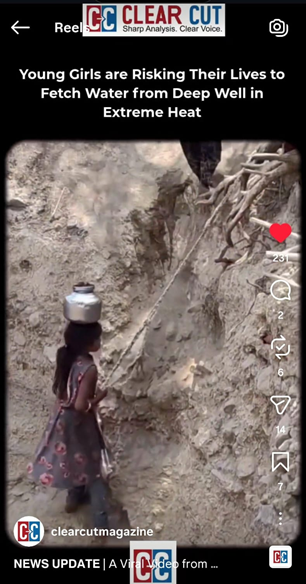
Videos like this remind people that in many areas, the struggle for basic drinking water is still not over. And the most heartbreaking part, the burden often falls on children. Khargone is also known for its extreme summer heat, with temperatures regularly crossing 44–45°C during peak season, making this struggle even more dangerous for children. This is not an isolated story; multiple stories can be seen from different areas.
India has been making continuous efforts through public funding to provide access to drinking water, especially targeting vulnerable areas. Despite such efforts, access to safe drinking water remains a challenge in many rural regions; for instance, only 16% of rural households had individual household tap connections in 2019 (Government of India, Dashboard- Jal Jeevan Mission ‐ Har Ghar Jal 2023 ).
The Missing Localities
According to WHO’s recent data, shows that drinking water coverage has improved considerably in India with 89 percent of the rural population having access to an improved water source within a round trip of 30 minutes. Fifty percent of rural households have a tap connection within the dwelling or premises according to the Department of Drinking Water and Sanitation, Ministry of Jal Shakti, Government of India, 2022.
Jal Jeevan Mission
Intending to achieve the Sustainable Development Goal (SDG-6) and ensure inclusivity in access to drinking water, the mission has fast-tracked the process of providing individual tap water connections to every household with the provision of 55 litres of water per capita per day. Since the launch of JJM in 2019, when the coverage of rural households was 16.63%, the mission has managed to cover 3/4th of rural households in the country. One of the distinct features of the mission is that it focuses more on service delivery, which includes sufficient, reliable, and regular supply of drinking water through household tap connections rather than simple creation of infrastructure.
Moreover, with the scope of decentralized governance for monitoring the program uptake at the state (State Water And Sanitation Mission), district (District Water and Sanitation Mission) and village level (Village Water And Sanitation Committee) along with a greater community engagement, the mission holds a significant potential spillover effect in addressing health issues, lower educational attainment of girl children, lower women participation in the labour market, and also possesses the capacity to generate economic activities in various phases of its implementation.
Significant progress has been made in the country since the launch of the Jal Jeevan Mission, towards enhancing access to tap water to rural households. At the time of the announcement of the Jal Jeevan Mission in August 2019, only 3.23 Crore (17%) rural households were reported to have tap water connections. So far, as reported by States/ UTs as on 04.02.2024, an additional 11.01 Crore rural households have been provided with tap water connections under JJM. Thus, as on 04.02.2024, out of 19.27 Crore rural households in the country, more than 14.24 Crore (73.93%) households are reported to have tap water supply in their homes.
A few of the major challenges being faced by the States in the implementation of the Jal Jeevan Mission are listed as follows:
- Lack of dependable drinking water sources in water-stressed areas,
- Presence of geo-genic contaminants in groundwater,
- Uneven geographical terrain, scattered rural habitations,
- Lack of capacity of the local village communities to manage and operate in-village water supply infrastructure.
The Water Crisis
India is suffering from the worst water crisis in its history and millions of lives and livelihoods are under threat. NITI Aayog report says that currently, 600 million Indians face high to extreme water stress and about two lakh people die every year due to inadequate access to safe water. The crisis is only going to get worse. By 2030, the country’s water demand is projected to be twice the available supply, implying severe water scarcity for hundreds of millions of people and an eventual ~6% loss in the country’s GDP. As per the report of the National Commission for Integrated Water Resource Development of MoWR, the water requirement by 2050 in a high-use scenario is likely to be a milder 1,180 BCM, whereas the present-day availability is 695 BCM. The total availability of water possible in the country is still lower than this projected demand, at 1,137 BCM. Thus, there is an imminent need to deepen our understanding of our water resources and usage and put in place interventions that make our water use efficient and sustainable. The National Institute for Transforming India (NITI) Aayog has developed the Composite Water Management Index (CWMI) to enable effective water management in Indian states in the face of this growing crisis. The Index and this associated report are expected to: (1) establish a clear baseline and benchmark for state-level performance on key water indicators; (2) uncover and explain how states have progressed on water issues over time, including identifying high-performers and under-performers, thereby inculcating a culture of constructive competition among states; and, (3) identify areas for deeper engagement and investment on the part of the states.
The Unequal Labour & Crisis
UNICEF said the 200 million hours women and girls spend every day collecting water is a colossal waste of their valuable time.
As World Water Week gets underway in Stockholm and experts gather to try to improve the world’s access to water, the UN children’s agency stressed that the opportunity cost of lack of access to water disproportionately falls on women.
“Just imagine: 200 million hours is 8.3 million days, or over 22,800 years,” said UNICEF’s global head of water, sanitation and hygiene Sanjay Wijesekera. “It would be as if a woman started with her empty bucket in the Stone Age and didn’t arrive home with water until 2016. Think how much the world has advanced in that time. Think how much women could have achieved in that time.” He added, “When water is not on premises and needs to be collected, it’s our women and girls who are mostly paying with their time and lost opportunities”.
The UN’s Sustainable Development Goal for water and sanitation, Goal 6, calls for universal and equitable access to safe and affordable drinking water by 2030. The first step is providing everyone with a basic service within a 30-minute round trip, and the long-term goal is to ensure everyone has safe water available at home.
Childhood should mean school, play, and safety, not risking your life under extreme heat just to bring water home. India’s Jal Jeevan Mission was launched with the promise of providing tap water access to every rural household. Government data says crores of households have already received connections under the scheme.
Clear Cut Health, WASH Desk
New Delhi, UPDATED: June 04, 2026 09:00 IST
Written By: Muskan Pal