
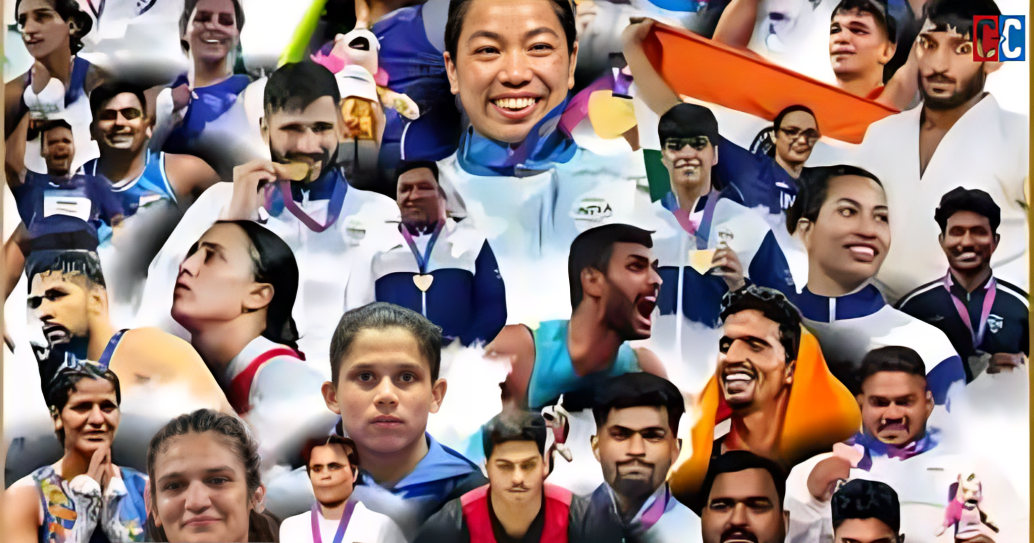
- India finished 4th at the Commonwealth Games Glasgow 2026 with 39 medals (13 Gold, 17 Silver, 9 Bronze), proving its sporting progress despite the absence of several traditional medal-winning events.
- The success reflects the long-term impact of initiatives like TOPS and Khelo India, along with stronger grassroots development, women athletes, and para-sports contributing significantly to India’s medal haul.
This was a type of photo that used to capture India at the Commonwealth Games: a small, earnest group of athletes walking behind the flag in an opening ceremony, which were there less as they were hoping to win medals, and more as they were staging a gesture of Commonwealth belonging. This picture is a thing of the past now. India finished the Glasgow 2026 Games fourth on the medals table with 39 Medals (13 Gold, 17 Silver, 09 Bronze) secured by 122 athletes in 08 able-bodied sports and five para sports. It’s not necessarily a golden generation of Indian athletes that the tale of reaching the middle of the podium from the margins of that photo is about, but a very gradual reshaping of how India produces them.
A Podium Built Over Decades
India has now won 564 medals in all (203 gold, 190 silver and 171 bronze) to become the fourth best-gamed country in the history of the Commonwealth Games. That’s an astonishing figure for a nation that has played on the fringes of the table for its first few decades. It was in New Delhi 2010, when the host Games had a significant impact due to a variety of factors such as better facilities, easier selection pathways, and sheer public attention, that India had landed its best single-Games haul with 101 medals to secure the second position in the medal table. The significance of 2010 was not the single peak, but that the number never really dropped off. The totals at Glasgow 2014, Gold Coast 2018 and Birmingham 2022 are well above India’s pre-2010 levels, indicating a base shift rather than just a spike.
Why Glasgow 2026 Mattered More Than the Numbers Suggest
Paper 2026 should have been a tougher one for India than an easier one. The Indian team in Glasgow had been deliberately pruned to a small size and some of the disciplines that had once held hopes of Indian medals were excluded, such as wrestling, badminton, table tennis, hockey and shooting. Perhaps the data that captured India’s attention, ahead of all of its previous, wide-reaching campaigns, was the fact that the nation made it to fourth place without its customary ‘crutches’.
Boxing took the heaviest beating, with a record 10 medals won, seven golds – most golds medals ever won by any country in boxing at a Commonwealth Games. Athletics provided its own headlines with Gulveer Singh becoming India’s first double Games medallist with silver in the 10,000m and bronze in the 5,000m, while Tejaswin Shankar became the country’s first ever Commonwealth decathlon medallist and Neeraj Chopra bounced back after a Birmingham 2022 absence due to injury to add a silver in the javelin. Two other numbers deserve equal billing: eight of India’s 13 gold medals were won by the women athletes; and the para team produced its finest Commonwealth game, with seven medals, which matched the number of medals won by the Indian athletes in all previous editions combined.
The Machinery Behind the Medals
Nothing happened by chance, and it’s important to specify the plumbing. Much of the credit goes to two mutually dependent government programmes. Established in 2014, the Target Olympic Podium Scheme (TOPS) has been revamped in 2018 with an exclusive technical support arm and currently supports 51 core athletes, 52 para core athletes and 130 developmental athletes, and has been known to help India get medals at the Tokyo and Paris Olympics.
Under TOPS is the larger roof of grassroots-to-sport structures, known as Khelo India, which was created in 2017 by integrating existing projects like Rajiv Gandhi Khel Abhiyan under a single umbrella. With the Khelo India Games starting in 2018, over 63,000 young athletes have been playing in the school, university and regional-based tournaments, which is just the kind of regular competition that a talent pipeline should have and not be waiting for chance exposure to find.
A newer initiative, Khelo India Rising Talent Identification programme, which is based on standardised testing and data analytics, is being conducted in over 170 talent assessment centres to identify talented children aged 9-18 for a systematic identification process instead of relying on which village might have a good coach. A few weeks before Glasgow, the government in a major move approved a much beefed-up, much better funded version of Khelo India, specifically designed to pass this pipeline from grassroots fields to the Olympic podium, with a particular focus on increasing opportunities for women and para-athletes – the exact two groups that will take the storylines of Glasgow to the Olympic platform.
The Real Story Isn’t the Medal Count
The impression to be gained from Glasgow 2026 is the impression to be gained from any other occasion on which you’ve seen a good performance. Structural, a nation whose sporting pedigree hinged on a handful of sports and a home crowd is sufficiently institutionalised in terms of funding, talent identification and sporting infrastructure that it can lose access to half of its strongest sports and still come fourth in the world. This isn’t a tale of good fortune for athletes. It’s a tale of a system that for some reason is beginning to do what it’s supposed to do.
Clear Cut Award & Events Desk
New Delhi, UPDATED: August 05, 2026 09:00 IST
Written By: Subhanshu Jaiswal
Designation: Assistant Manager – MLE at Devinsights