- India’s fourth Singapore Ministerial Roundtable aims to expand trade, agri-food exports, investment, and skills cooperation, creating new opportunities for farmers and young workers.
- The real impact will depend on whether these agreements translate into better market access for small farmers and sustainable, portable skills and jobs for India’s youth.
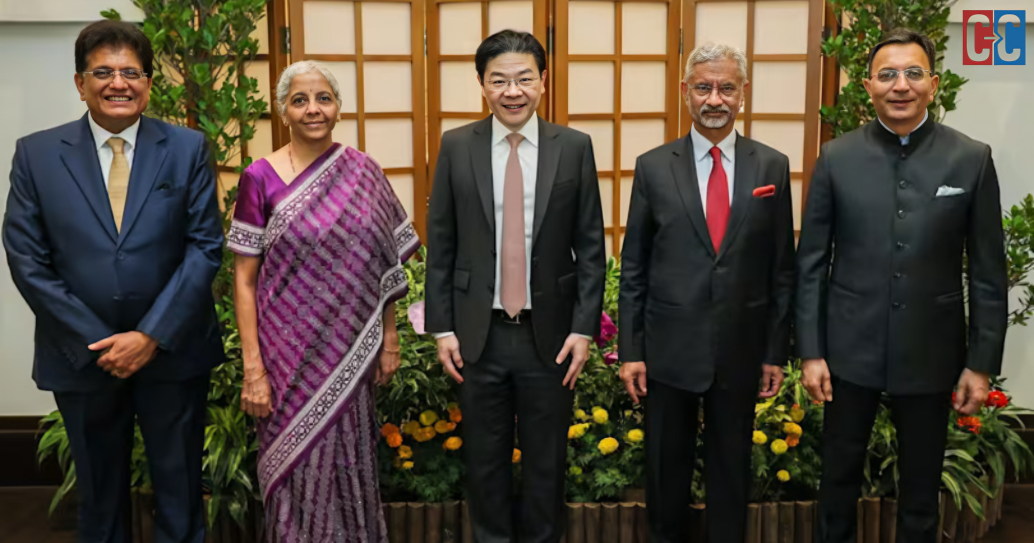
Singapore supplied nearly a third of every foreign investment dollar that entered India last financial year — more than any other single country. That fact explains why, on 20 August, a five-member ministerial delegation led by Commerce and Industry Minister Piyush Goyal joined a 70-strong Indian business contingent in Singapore for the fourth India-Singapore Ministerial Roundtable (ISMR), a mechanism serious enough this year to draw the finance, external affairs, commerce, and electronics ministries into the same room at once.
According to Commerce Ministry figures cited around the visit, Singapore’s FDI equity inflows into India reached $19.8 billion in 2025-26 — 33.6 percent of the country’s total inflows of $58.85 billion — taking cumulative Singaporean investment since 2000 past $194.68 billion and keeping it ahead of Mauritius, its closest rival as a source of Indian FDI. Bilateral trade has grown more than fivefold in two decades, from $6.7 billion in 2004-05 to $36.1 billion in 2025-26, and Singapore remains India’s largest trading partner within the ASEAN bloc.
Held alongside the fourth India-Singapore Business Roundtable and followed by an MoU-signing ceremony, the visit’s headline numbers sit atop two threads that matter more directly to people who will never sit at a roundtable: farmers and food processors chasing new markets, and young workers chasing certified, portable skills.
At an APEDA-Fair Price roadshow at Singapore’s City Square Mall, Goyal said the promotion covered Indian organic produce, including fruits and vegetables, dairy, cashew, rice, and millet-based products, “sourced from different regions of India.” He framed the event as giving farmers and food processors a foothold in Singapore’s retail market, potentially extending into the wider ASEAN region and Australia. Whether that foothold reaches smallholders or is captured mainly by larger exporters will depend on market-access follow-through that a roadshow alone cannot guarantee.
The delegation’s other social wager is skilling. Indian officials also visited Singaporean 0, discussing cooperation on semiconductor and aircraft-maintenance training as part of the skills-development pillar, which has featured in every round of the ISMR since 2022. A 2025 report by the Institute of South Asian Studies at the National University of Singapore, co-authored by economist Amitendu Palit, casts the collaboration in demographic terms: India is racing to upskill a young workforce entering the labour market every year, while Singapore, ageing and moving fast on digital transformation, is aligning its own training institutions with India’s — complementary demographics rather than one-sided aid.
That approach echoes a strategy India has already tested with Japan, whose 2021 mobility agreement trains Indian workers for eventual placement across 14 specified sectors — a template New Delhi reinforced just last week through a fresh round of talks on skilling and workforce mobility.
The Singapore push lands amid a rockier year for India’s trade with its largest single-country market. Washington’s tariffs on Indian goods peaked at nearly 50 percent in 2025 before being scaled back under an interim framework this year — a shock that has left exporters more wary of relying on any one destination. Ajay Sahai, director general of the Federation of Indian Export Organisations, says the industry has grown markedly more risk-averse regarding market concentration, now treating diversification into markets such as ASEAN as a deliberate hedge rather than an afterthought — though he cautions that the shift will take a few years to show measurable results. That timeline matters most to labour-intensive exporters in textiles, gems, and marine products, where jobs, not just revenue, are at stake.
Roundtables often generate MoUs. Livelihoods are either made or lost in the days following the delegates’ departure. The real measure of this fourth ISMR will extend far beyond the splash of the headlines of this week, assessing if it effectively translates promises of smallholder market access and skills transfer into sustainable income streams for farmers, food processors, and new young workers, and if not, whether the relationship will still add up in dollars.
India–Singapore Economic Ties: Key Figures
| Indicator | Figure |
| Singapore FDI into India, FY 2025-26 | $19.8 billion (33.6% of India’s total FDI inflows) |
| Cumulative Singapore FDI, April 2000–March 2026 | $194.68 billion (24.72% of total) |
| Bilateral trade, FY 2004-05 | $6.7 billion |
| Bilateral trade, FY 2025-26 | $36.1 billion |
| Indian business delegation to the 4th ISMR | ~70 senior leaders across 8 sectors |
Source: Government of India, Ministry of Commerce and Industry, as reported around the 19–21 August 2026 visit.
Clear Cut Livelihood Desk
New Delhi, UPDATED: August 24, 2026 18:30 IST
Written By: Yatharth Pathak