


The notification of all four national labour codes on 21 November 2025 marks one of the largest legislative overhauls of India’s employment framework in decades. In an effort to modernize rules on wages, industrial relations, safety, and social security, the government replaced twenty-nine fragmented laws with four broad codes. The reform has promised simplicity and wider coverage, but analysts argue that such changes have serious gaps, unresolved contradictions, and financial burdens on employers and enforcement agencies. The challenge now is to understand not only what the codes aim to achieve but also where they may fall short.
A Consolidation That Helps on Paper but Raises Practical Questions
These codes synthesize older laws into clearer categories, which is helpful because India’s labour system had grown into a patchwork of overlapping statutes. For example, the Wage Code does away with multiple minimum wage Acts. The code on social security creates one framework for provident fund, pension, insurance and maternity benefits. On paper, this consolidation brings consistency. But in practice, clarity will depend on how states interpret and apply the rules.
Many of the earlier laws were criticized for being outdated; some were written decades ago when factory work dominated employment. The codes try to bring gig workers and platform workers into the system. Yet, many experts note that basic definitions remain incomplete. Several gig platforms still remain unclear about whether they fall under mandatory contributions or voluntary schemes. Labour economists caution that unless rules specify clearly the contribution formula and grievance systems, workers may not get any meaningful benefits.
Industrial Relations Code: The Most Controversial Part
Most criticism has focused on the Industrial Relations Code. It raises the threshold for seeking government approval for layoffs from a hundred workers to three hundred. The government says that this would encourage firms to expand without fear. Trade unions say that it weakens job security. Both the arguments contain an element of truth.
Economists cite data from the Annual Survey of Industries that shows firms in the one hundred to three hundred range already avoid hiring permanent staff. Firms use contract workers to bypass rigid laws. Raising the threshold may improve formal hiring for mid-sized firms. Large companies, though, might react by reorganizing operations to avoid crossing headcounts that trigger stricter rules, critics fear. Without strong monitoring, the code may shift workers from permanent to temporary contracts, weakening protections over the long term.
It also restricts the right to strike by requiring fourteen days’ notice, and it limits strike action during conciliation. Supporters believe this reduces disruptions. Unions say this makes collective bargaining weaker, particularly in mining, transport, and manufacturing sectors.
Costs to Small Businesses and States
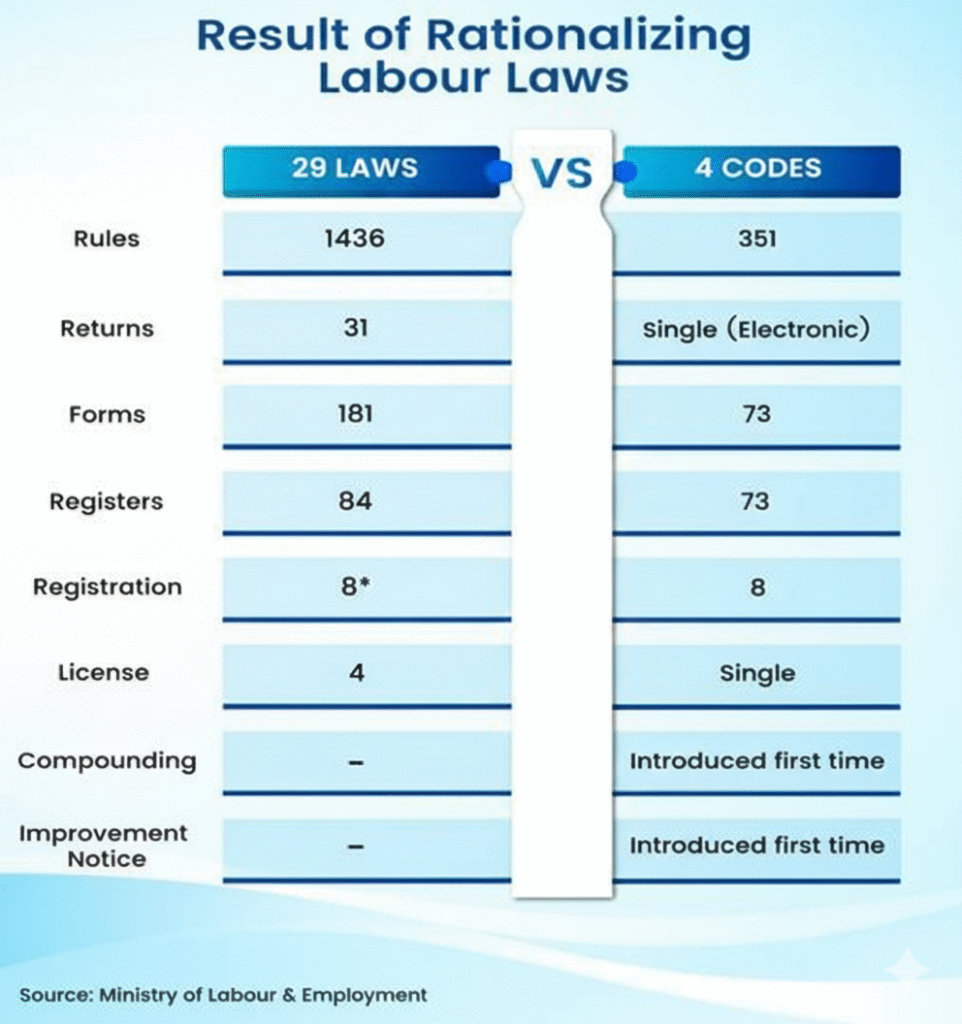
While the reform is business-friendly, small and medium enterprises expect more compliance costs. They will have to adopt digital wage systems, maintain new registers, file online returns, and provide the mandated safety facilities. For big firms, this is doable. For the micro and small units that already struggle with GST, provident fund and other filings, the cost of software, training, and legal advice is not insignificant.
But states face an equal challenge. Indeed, the codes require new inspections, digital platforms, and grievance systems. In several states, full-fledged online dashboards have not been created. If the experience with the Building and Other Construction Workers Act is anything to go by, welfare implementation falls apart if states lack administrative capacity. A code is only as good as the system enforcing it.
The Social Security Code: A good vision with unclear execution
Extension of social security to gig workers was long overdue. According to government estimates, India will have more than 13 million gig workers in 2024. The code recognises them as a distinct category but the mechanism to determine contributions from platforms remains unclear. The platforms argue they cannot sustain high contribution rates. Workers say without universal coverage, the law is symbolic.
International comparisons demonstrate that inclusion cannot work unless it operates in the presence of a neutral fund manager, strong dispute channels, and clear contribution sharing. Other countries like the United Kingdom and France have faced problems with similar frameworks. India runs the risk of falling into the same trap unless it creates a transparent, worker-centered model.
Delays That Undermine Trust
The codes were passed between 2019 and 2020. They were notified only in 2025. This five-year gap has created uncertainty. If companies had prepared for implementation multiple times only to see delays, it’s an expensive measure.
Balancing Economic Flexibility With Worker Protection
These codes are a significant attempt to modernize India’s labour system. They spell out measures to encourage investment, ease compliance, and widen social protection. Reforms will succeed if they successfully balance economic flexibility with genuine worker protection. If not strictly enforced, and without clear state-level rules and a strong system of taking care of workers’ grievances, the codes will become a cosmetic exercise that favours efficiency over equity. Whether India’s labour future improves will depend henceforth on whether states, unions, companies, and platforms can collaborate to make legislation translate to meaningful protection. The codes have created a new scaffold. The real test will be whether they spur better jobs.
Clear Cut Livelihood Desk
New Delhi, UPDATED: Nov,23 2025 02:33 IST
Written By: Janmojaya Barik